I have always been intrigued by the many ways scientists and engineers have devised to sense basic physical parameters such as temperature, pressure, voltage, current, and electric fields, to cite just a few. In some cases, the challenge is the wide dynamic range needed, while in other cases, it’s the need for extreme sensitivity and resolution of signals we are striving to capture.
Among the phenomena that we often want to measure with accuracy are magnetic fields, including the omnipresent, ubiquitous one of our Earth. Basic sensing and measurement of this field is not hard, and there are many electrical- and mechanical-based ways to do it.
Lately, there’s been increased interest in sensing the Earth’s field with great precision for several reasons. Such sensing can be used, for example, to better locate and identify underground mineral deposits and provide improved metal detection for security devices.
That last application may seem to make little sense at first glance. After all, we have GPS and we like to think that it’s always there, but that’s not the case at all. First, it’s unavailable underground or underwater. Second, there are GPS-denied scenarios where the signal is being jammed or spoofed.
In these cases, the ability to precisely measure changes in the Earth’s magnetic field and use them in conjunction with a detailed local or global magnetic-field map would be a valuable asset, enabling magnetic navigation or MagNav. One big benefit, of course, is that the signal can’t be jammed by “bad actors “and is available anywhere, except shielded rooms, of course.
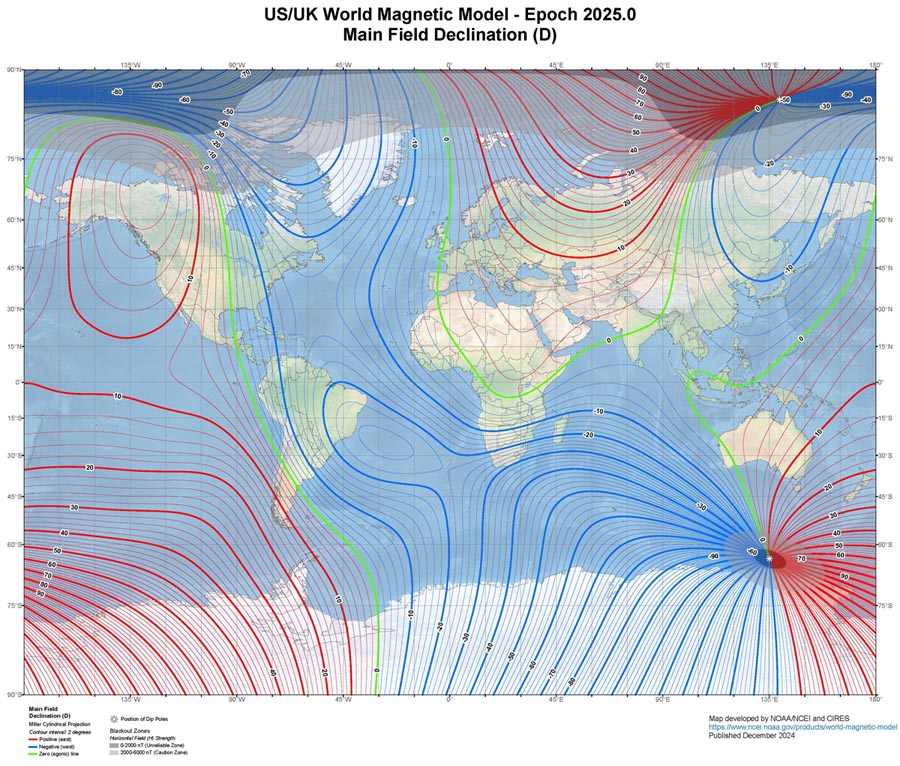
The needed magnetic map is readily available. The World Magnetic Model (WMM) [Ref. 1] from the United States National Centers for Environmental Information (NCEI) complied data with other countries. It’s the standard model for navigation, attitude, and heading referencing systems that use the geomagnetic field (Figure 1). The WMM is also used for civilian applications, including navigation and heading systems.
 |
|
| Figure 1. | World Magnetic Model is standard for the Earth’s magnetic field; other models and more details are available. Source: United States National Geospatial-Intelligence Agency and the United Kingdom Defence Geographic Centre. |
NCEI also developed the World Magnetic Model High Resolution (WMMHR) [Ref. 2], an advanced magnetic field model with more comprehensive data on the geomagnetic fields than the original World Magnetic Model. There are also privately-generated magnetic maps for highly localized areas.
What about magnetic measurements?
The challenge is that measurement of magnetic field strength and vector with high precision is difficult. Factors such as field intensity, sensor drift, and various forms of interference can affect conventional sensors.
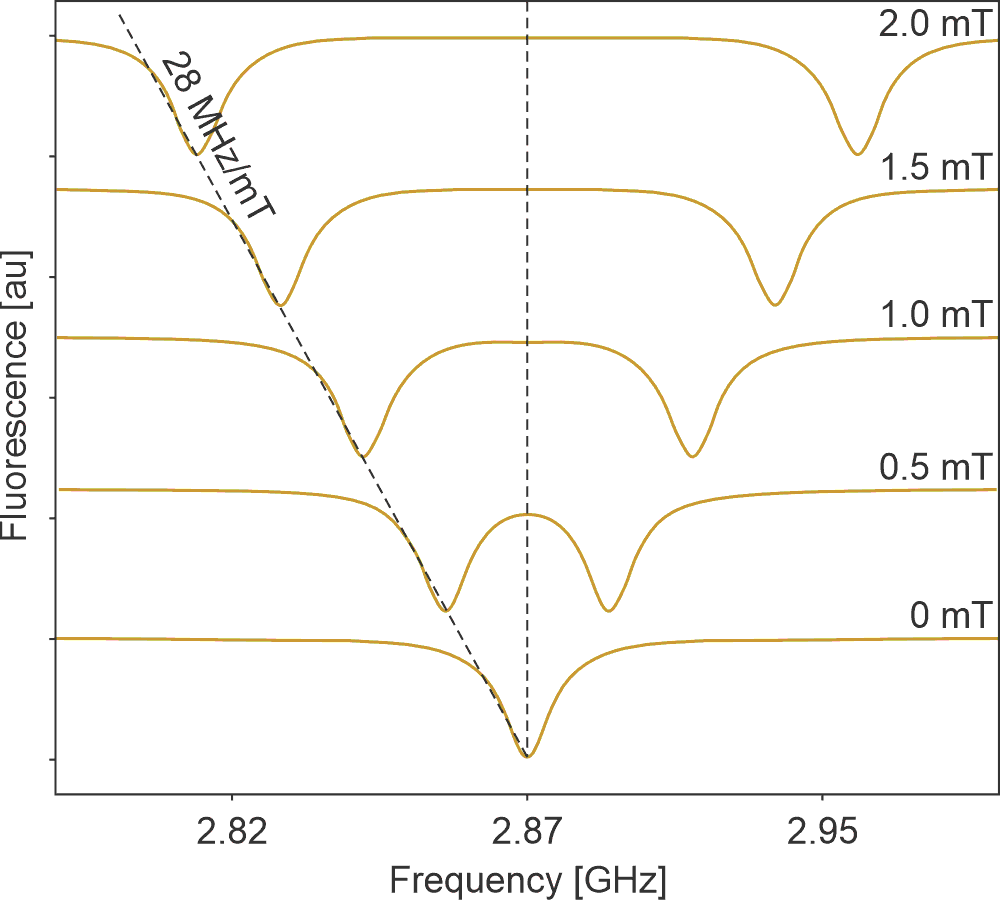
That’s why there is so much interest in quantum magnetometers based on nitrogen-vacancy (NV) centers in diamonds as perhaps the ultimate magnetic sensor. One source cites the present NV sensitivity, which is characterized by the gyromagnetic ratio as 28 GHz/tesla (T), which means it’s very sensitive to magnetic fields (Figure 2).
 |
|
| Figure 2. | This sensitivity graph and its sharp slope shows the performance of an NV-center implementation. Source: QZabre. |
They can measure the field with precision down to one-millionth of the Earth’s weak magnetic field of approximately 25 to 65 microteslas (µT). Furthermore, the stability of their quantum reference enables drift-free measurements, eliminating the need for constant calibration and recalibration and making comparison with more reliable data sets.
A major benefit of these analog sensors is that although they are based on quantum principles, it’s a room-temperature technique and does not require cryogenic or other cooling, unlike so many quantum computing devices. There’s another interesting aspect to these NV meters as well: because they are atomic-based, their use can be extended into nano- and micro-meter applications, including mapping the magnetic field of the brain’s neurons.
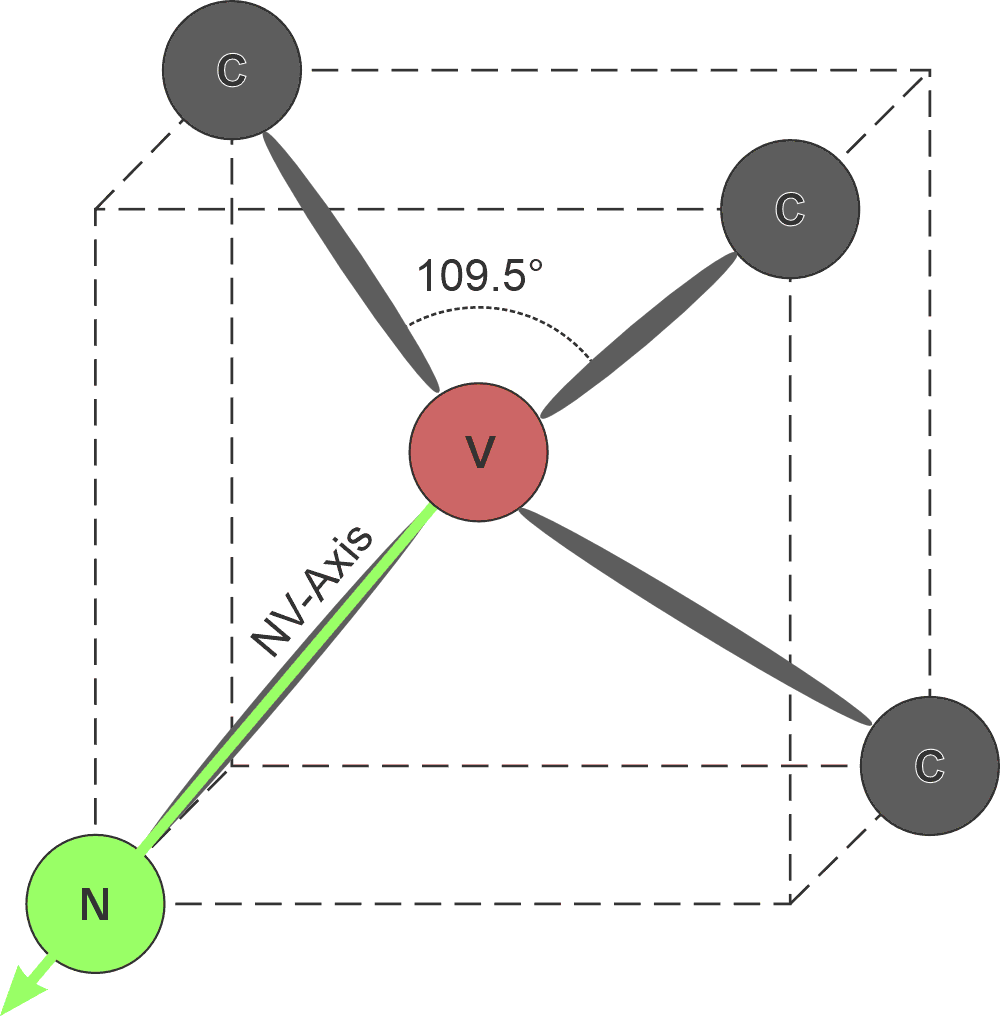
How does the NV center work? I’d like to say “in simplified terms, this is how” but that’s not possible. It’s inherently a very sophisticated story. However, in somewhat simplified terms, an NV center is a “point defect” in a lab-gown diamond lattice, in which a nitrogen atom replaces a carbon atom adjacent to a vacancy or empty lattice site in the crystal-lattice structure.
This aberration results in a two-electron spin system with unique quantum properties that can be optically initiated by a suitable laser and then interrogated, also by a laser (Figure 3).
 |
|
| Figure 3. | This simplified schematic drawing shows the physical situation of the NV principle. Source: Integrated Optics |
NV centers are well suited for magnetometry because of their quantum mechanical spin-1 property, which includes three energy levels: ms = 0, ±1. These energy levels are sensitive to the local magnetic field via the Zeeman effect, especially along the NV axis.
Visible (green) laser excitation polarizes the spin system and results in red light emission (photoluminescence); the intensity of this photoluminescence depends on the spin state. By applying microwave laser energy at resonant frequencies corresponding to the spin transitions, the fluorescence intensity dips. This action provides a means to detect magnetic fields via optically detected magnetic resonance. You’ve got all that, right?
As a result of the tetrahedral symmetry of the lattice, a diamond crystal typically contains NV centers in four orientations. With appropriate signal processing and a carefully applied bias-magnetic field, each orientation can be resolved, enabling full vector magnetometry.
Other benefits and challenges
These NV-center-based magnetometers aren’t only precise; they are also small and rugged. This unusual pairing contrasts with traditional high-sensitivity vector magnetometers, including superconducting quantum interference devices (SQUID) and vectorized atomic-vapor magnetometers that require cryogenics. NV magnetometers operate at room temperature with compact form factors and deliver similar or even superior performance in the field.
As they are based on a solid-state material – diamond – they circumvent the need to vaporize a vacuum cell, a process that requires heating elements that are apt to consume large quantities of energy. NV magnetometers can be placed close to magnetic noise sources such as batteries or metallic components. This means that they can be used to accurately map and compensate for platform-induced fields.
Of course, building an NV magnetometer is not easy. The efficient excitation of NV centers requires a powerful and compact light source in the green band, typically at 532 nanometers. Instabilities in the green excitation laser directly translate into noise in the photoluminescence signal.
This creates a need for advanced referencing systems and modulation techniques to suppress the effect. Although recent innovations to solid-state lasers and semiconductor diodes are making these devices more practical, these sources have historically been bulky, inefficient, or both.
The complementary action of capturing the photoluminescence is another issue of efficiency. NV centers emit red light (~637 to 800 nm) upon relaxation. Collecting enough of this light requires careful optical design due to the high refractive index and internal reflections of diamond. Extremely sensitive photodetectors and low-noise electronics are needed to read out potentially weak fluorescence signals from NV centers.
On the hardware side, making the basic NV center diamond is itself an extremely advanced process, as it involves working with individual atoms in a crystal lattice. On the software side, highly advanced algorithms are needed to process the captured signals and the data embedded within them, along with various correction and compensation factors.
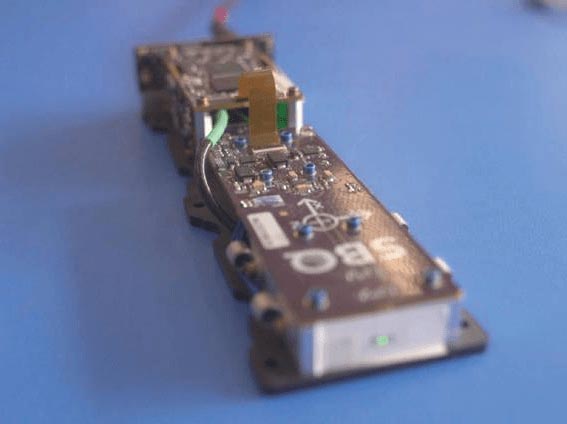
Is this advanced technique just a promising laboratory development? No, these NV systems are available and are used in a variety of mining and space-based magnetic-mapping projects (Figure 4). Among the vendors are Integrated Optics, SBQuantum, SandboxAQ, Leidos, Frequency Electronics, and QZabre.
 |
|
| Figure 4. | This NV-center magnetic-sensing unit is complete and ready to use. Source: SBQuantum. |
This is certainly a fascinating example of a micro- and macro-scale sensor with high sensitivity and extreme resolution. My question is: who came up with this idea? What led them to it? What is developed via a deep understanding of quantum physics and then a flash of insight, or was it uncovered” by accident? When and if I have time, I’d like to do some historical research, that’s for sure.