Combining an accurate temperature sensor with a standard digital multimeter can make an inexpensive, accurate, and useful thermometer.
A recent Design Idea, BJT is accurate sensor for absolute temperature in Kelvin and Rankine (Ref. 1), was based on a 1991 application note (Ref. 2) by a legendary guru, the forever remembered Jim Williams. In his article, Williams demonstrated that, when used as ΔVBE sensors, ordinary unselected transistors give temperature readings accurate to a fraction of a degree without calibration:
“…randomly selected 2N3904s and 2N2222s… showed less than 0.4 °C spread over 25 devices from various manufacturers.”
As shown in BJT is accurate…, the basic math of ΔVBE can be cooked down to a simple and easy to remember (hah!) linear-in-absolute-temperature relationship:
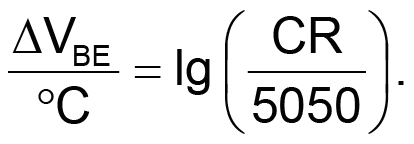
(Here CR is current-ratio.) So, if we need any given ΔVBE/°C, the required
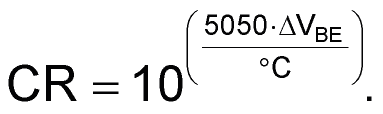
For example, for ΔVBE/°C = 100 μV,

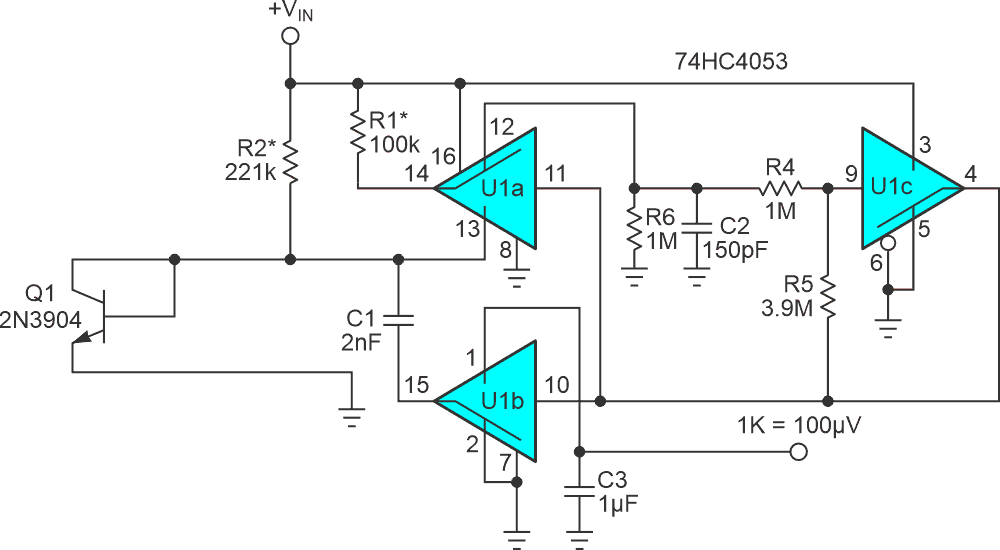
This ratio is implemented in Figure 1’s simple circuit for a 100 µV per Kelvin output.
 |
|
| Figure 1. | An ordinary BJT Q1 makes an accurate 100 µV per unit Kelvin absolute temperature sensor. |
Okay. So. What’s it good for? One plausible application is, as frequent contributor Nick Cornford has shown in several ingenious designs:
- Newer, shinier DMM RTDs – part 1 (Ref. 3) and part 2 (Ref. 4)
- Dropping a PRTD into a thermistor slot – impossible? (Ref. 5)
- DIY RTD for a DMM (Ref. 6)
that the combination of an accurate temperature sensor with a standard digital multimeter can make an inexpensive, accurate, and useful thermometer.
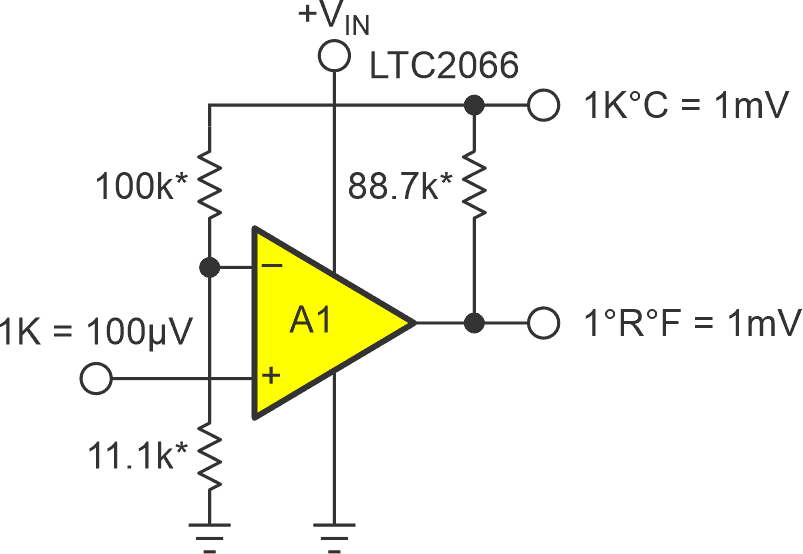
Nick’s favorite sensor is the super-versatile platinum RTD, but as Williams showed, a humble (and super cheap) 2N3904 (or similar) BJT might also fill the bill. That’s assuming that its package-limited –55 to +150 °C temperature range is adequate. And that’s also assuming that it gets a little help from its friends, such as Figure 2’s zero-drift op amp that boosts the output span to a DMM-friendly 1 mV per unit Celsius, Kelvin, Fahrenheit, and Rankine.
 |
|
| Figure 2. | A zero drift, 5 µV max offset A1 rescales 100 µV/°K by 10x to 1 mV/°C and by 18x to 1 mV/°F. |
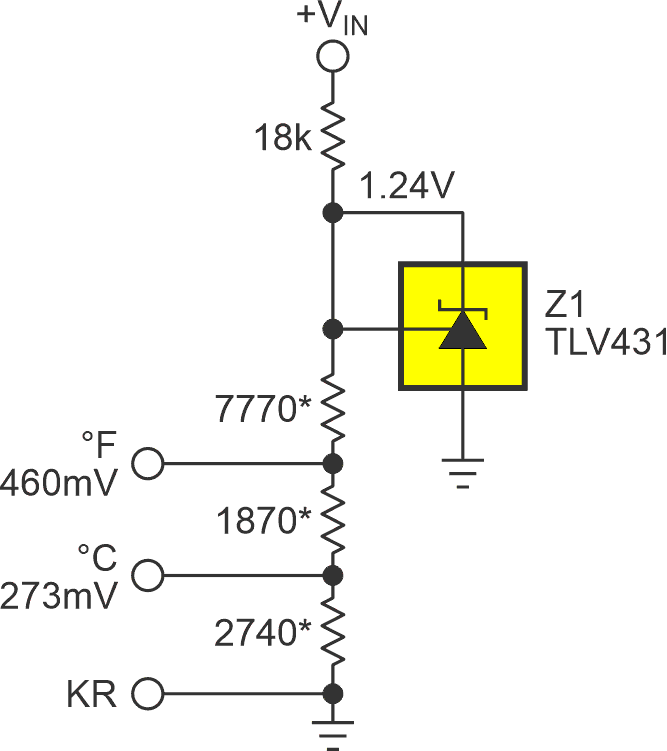
Of course, Kelvin and Rankine absolute temperature measurements are absolutely less frequently useful than the common Celsius and Fahrenheit scales…which is where Figure 3 comes in.
 |
|
| Figure 3. | Connect the DMM’s plus lead to the appropriate figure 2 output, and the minus lead to the correct precision 0° offset terminal, to re-zero 273K to 0°C and 460R to °0F. |
V+ can be anywhere from 3 to 6 volts. Current consumption at 3 V is barely more than 1 mA, dominated by the Z1 shunt reference, so two AAs will support 2000 hours (nearly three months) of continuous operation. A single CR2032 lithium coin will hold up for 10 non-stop days.
Thanks, Nick and Jim!
References
- Woodward, Stephen. "BJT is accurate sensor for absolute temperature in Kelvin and Rankine."
- Williams, Jim. Measurement and Control Circuit Collection."
- Cornford, Nick. "Newer, shinier DMM RTDs – part 1."
- Cornford, Nick. "Newer, shinier DMM RTDs – part 2."
- Cornford, Nick. "Dropping a PRTD into a thermistor slot – impossible?"
- Cornford, Nick. "DIY RTD for a DMM."