Simple to build, but serious instrument for monitoring and predicting weather disasters
Lightning detectors are devices designed to detect the presence of lightning strikes. These detectors utilize various technologies to sense the electromagnetic signals like detecting of radio frequency (RF), electric field change, magnetic field, optical detectors, as well as combined systems.
 |
|
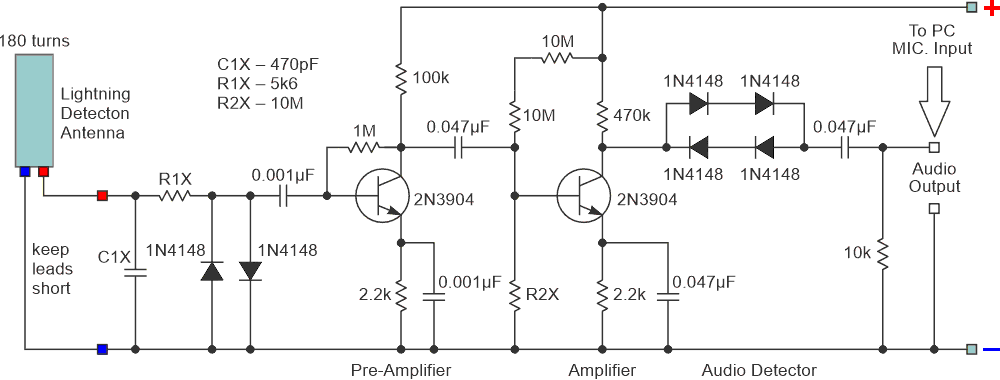
| Figure 1. | Schematic diagram of a lightning detector. |
This time I will describe to you how to make a very simple lightning detector (Figures 1 and 2), which with the help of a personal computer with a sound card, and simple software turns into a serious instrument for monitoring and predicting weather disasters.
 |
|
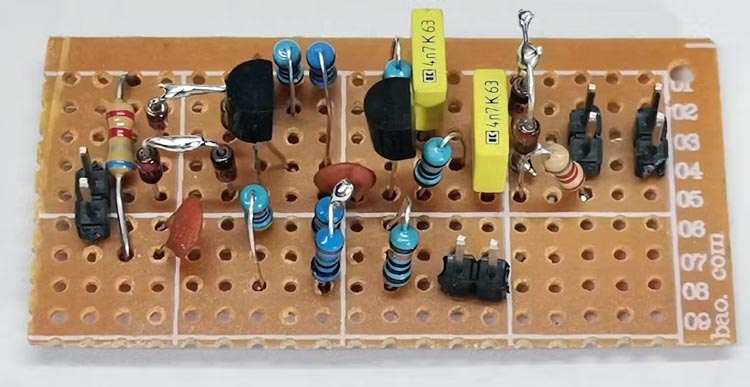
| Figure 2. | Lightning detector circuit assembled on a breadboard. |
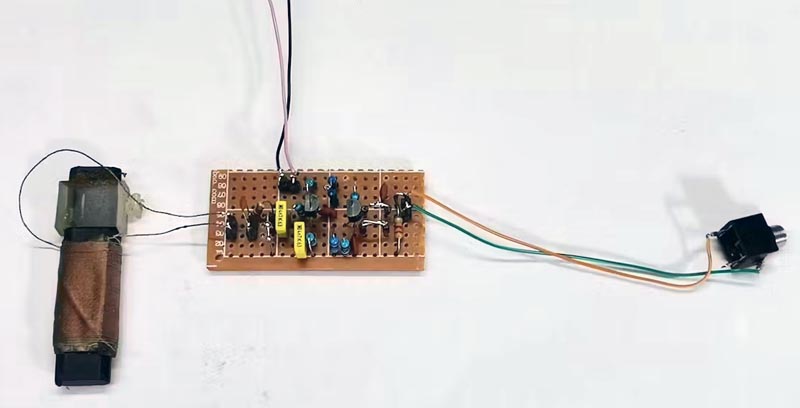
The range of this device (Figure 3), depending on the strength of the strike, and the length of the antenna ranges up to 100 km.
 |
|
| Figure 3. | Lightning detector with PC graph. |
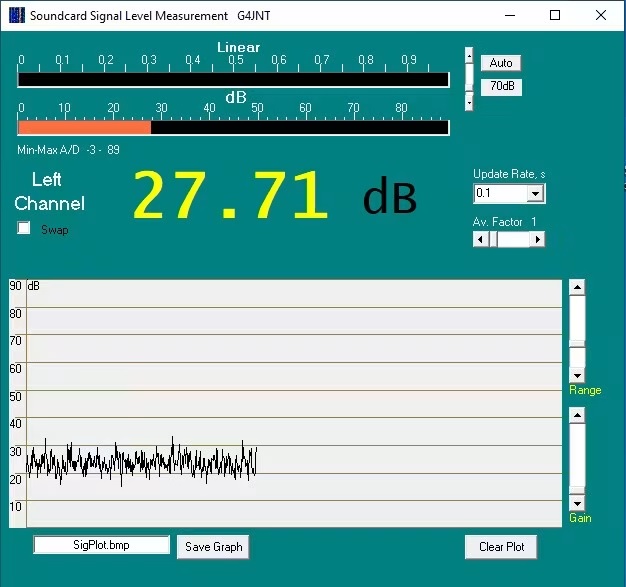
On the PC software, we get information about the number of thunderstorms, as well as their intensity in the form of a graphic display for the last ten minutes. If the amplitudes and frequency of shocks increase over time, it is almost a sure sign that a storm is approaching.
As I mentioned before, the device is very simple to build and consists of the following components:
- Two NPN transistors,
- 6 diodes 1N4148,
- several resistors and capacitors,
- detecting coil (180 turns on a ferrite core with a diameter of 1 cm and a length of 10 cm),
- and a rod antenna from an old pocket radio.
Now let's see how the device works in real conditions.
First, we need to connect the output from the detector to the microphone input from the sound card, and then start the software (Figure 4).
 |
|
| Figure 4. | Graphical representation of thunderstorm phenomena. |
As for the "SignalMeasure" application, it was downloaded from the G4JNT site (Ref. 1) and is actually an audio amplitude signal monitor. The electronic circuit transforms the thunder into an audio signal, and then this signal is monitored on the PC application. On the application we can set the sampling frequency, and if it is set to 1 sec, the graph shows us the events of the last 8 minutes.
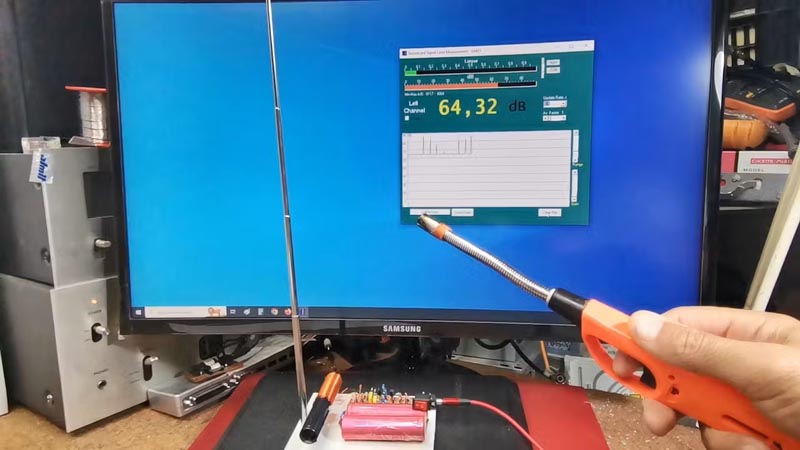
First we will test the device with an electric lighter (Figure 5).
 |
|
| Figure 5. | Testing the device using an electric lighter. |
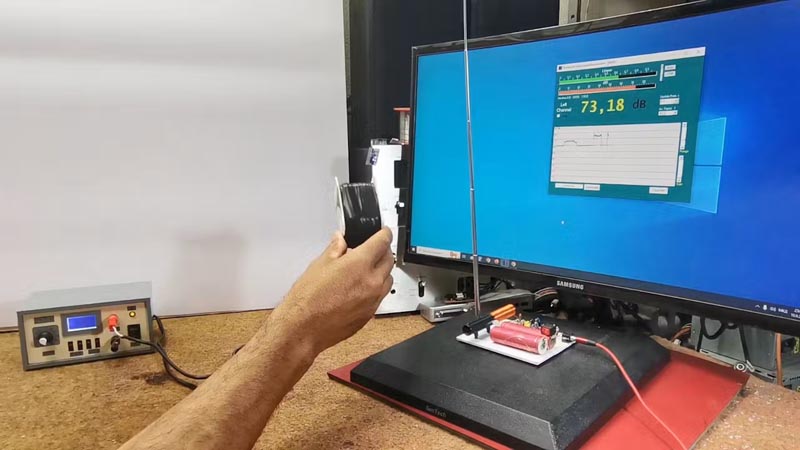
This device is sensitive to magnetic field. To test this feature I am going to use this PEMF device which is actually a variable magnetic field generator (Figure 6).
 |
|
| Figure 6. | Testing the device using a PEMF device. |
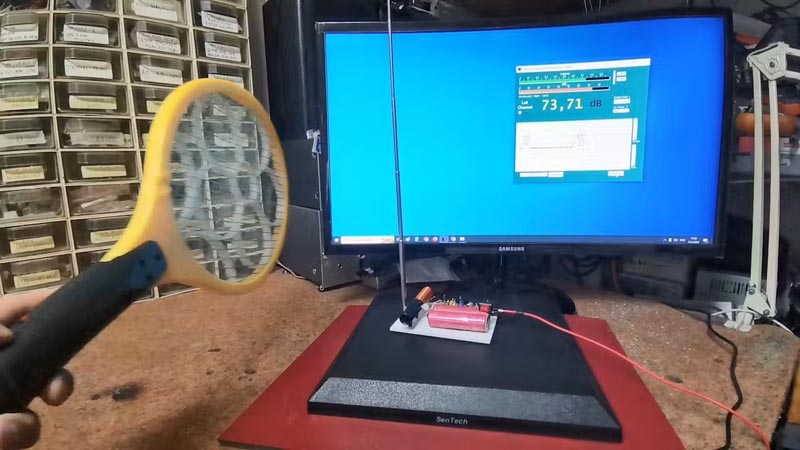
The device is also sensitive to electrostatic charge. As a source of electrostatic charge I use insect killer (Figure 7).
 |
|
| Figure 7. | Testing for sensitivity to electrostatic charges. |
And now comes the most interesting part, to "catch" lightning in real time, and see how it looks visually on the graph. I live in Ohrid, a small town in Macedonia, and during the initial tests of the device when the development was at a very early stage, there was a relatively strong storm with electrical discharges in my area, and the graphic display of that storm was beautiful, with frequent peaks with large amplitudes. Unfortunately, I don't have any recordings from this period.
If I have "favorable conditions" during the time I upload the video, I will make new recordings with which I will update this section.
And finally, a short conclusion. This is really a very simple electronic device, it does not represent any innovation and I have made such and similar devices many times before. However, the idea to present the lightnings visually in time with the help of a PC sound card is new. With the help of very basic software, which is actually a sound recorder, we turn this device into a powerful tool for monitoring and forecasting storms that has a very significant practical application, especially in this particular period of global warming.
My next project in this area will be to add an Arduino A/D converter to this device and with special PC software to continuously monitor electrical discharges in the environment 24/7.