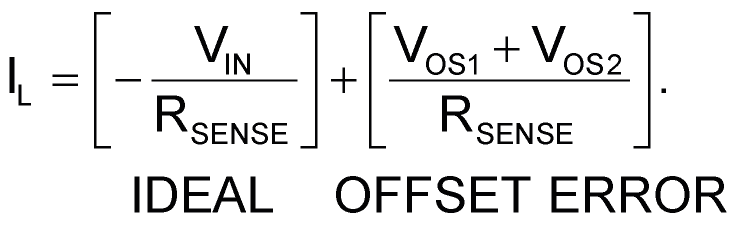
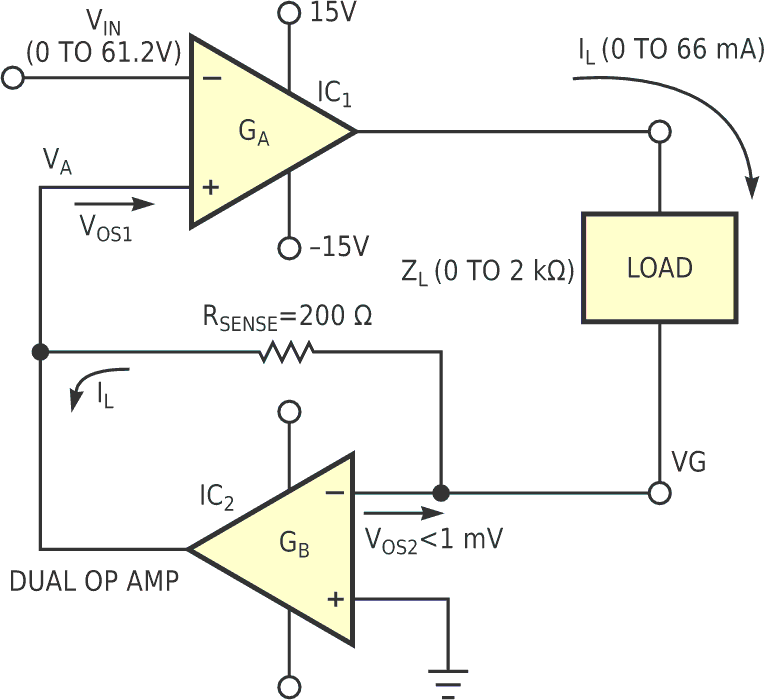
Current sources are useful in many areas of electronics, such as voltage and current division, current transmitters, excitation of thermistors, RTDs, bridges, potentiometers, and circuit biasing. Current sources are either fixed- or adjustable-current types. For the dual-op-amp current source in Figure 1, the load current, IL, is adjustable by varying VIN (0 to ±1.2 V), according to the following equation:
 |
|
| Figure 1. | A ±6-mA current source has a ±12 V compliance range. |
The maximum variation in load current is ±6 mA for a 200 Ω current-sensing resistor, RSENSE. This variation yields a maximum load voltage of ±12 V (3 V less than the supply voltages). The maximum current-offset error is 0.01 mA for VOS1 and VOS2 of 1 mV. This amount of offset is normal for lower grade op amps. Note that you connect one end of the load to virtual ground (VG). Amplifier IC1 acts as a voltage-error driver, and the transconductance amplifier, IC2, senses the load current and converts it to VA. The control equations are:
 |
(1) |
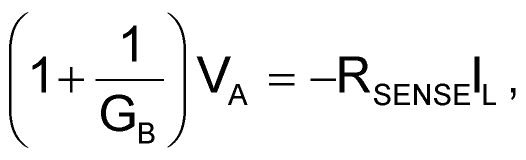 |
(2) |
where G equals open-loop gain; and
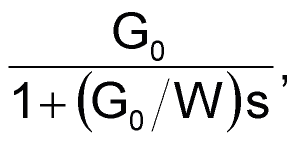 |
(3) |
where G0 = dc gain, W = unity-gain bandwidth, and s = jω complex frequency.
Solving equations 1 and 2 for IL and substituting G in Equation 3 for GA GB, the load current becomes:
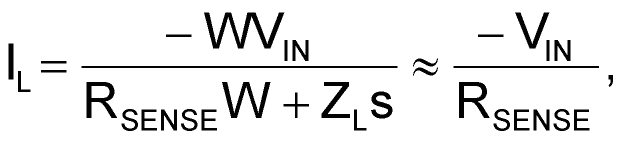
which demonstrates the load current's insensitivity to the load, ZL, for RSENSE >> ZLW,