Tracking down rodentia (or otherwise)-caused cable cuts, and differentiating them from normal open circuits, is critical. Evolving the circuit design for expanded functionality makes it even more valuable.
It’s just part of the job. Every design engineer learns early (if not so happily) about the inevitable necessity of detecting, confronting, and swatting “bugs” in circuitry.
In a recent Design Idea (Ref. 1), frequent contributor Jayapal Ramalingam extends this art of circuit defect detection and deletion from dealing with mere insects to coping with something much more formidable: rats!
With so many rodents and creatures around the plant, a cable cut can happen at any time.
The cables being subjected to those toothy threats transport signals from field contacts monitoring pressure, temperature, valve position, limit switches, manual operator inputs, etc., to process control systems. The possible consequences of mistaking an undetected cable break for an open contact range from the merely inconvenient to the catastrophic. An example of the latter might be a critical valve that’s actually open but erroneously read as closed – viz., Three Mile Island?
Mr. Ramalingam’s clever solution to the problem of undetected cable cuts is a current transmitter design that adds a third current level to the two that are inherent to an ON/OFF contact. Thusly.
- 20 mA = contact closed, cable intact
- 4 mA = contact open, cable intact
- 0 mA = cable cut, contact state unknown
It therefore explicitly verifies cable continuity, preventing the mistaking of an open circuit for an open contact. See his article (Ref. 1) for details.
 |
|
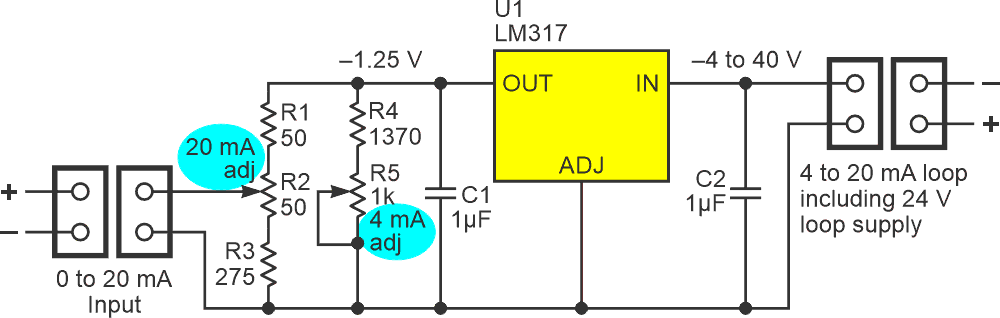
| Figure 1. | 0/20 mA to 4/20 mA current loop converter. |
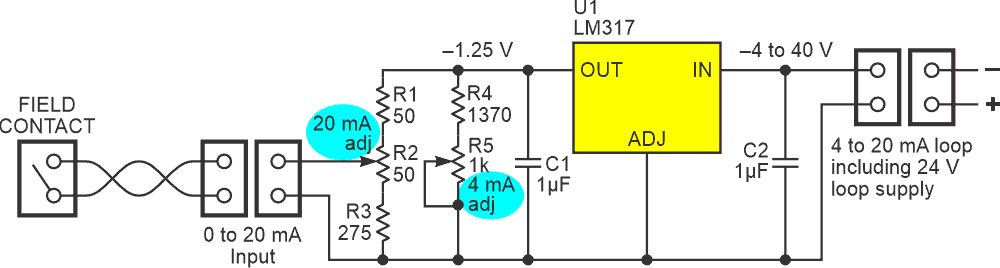
Mr. Ramalingam’s circuit works, is proven, and has nothing significantly wrong with it. Its utility, however, is limited to that single function. It might be significantly more convenient and thrifty if its role could be combined with another in a multipurpose design, provided, of course, that said design would be of no greater cost or complexity than the single-purpose transmitter. Figure 1 and Figure 2 show such a circuit adapted from an earlier article (Ref. 2).
 |
|
| Figure 2. | Field contact OFF/ON to 4/20 mA current loop converter. |
Note that the circuits are identical, so that only one design needs to be fabricated, documented, and stocked.
Calibration in this new role is quick and simple and completed in a single pass:
- Open contact.
- Tweak 4 mA adj for 4 mA output.
- Close contact.
- Tweak 20 mA adj for 20 mA output.
References
- Ramalingam, Jayapal. "Is your PLC/DCS reading the field contacts reliably?"
- Woodward, Stephen. "Silly simple precision 0/20mA to 4/20mA converter."