It’s always gratifying when a simple and successful design idea luckily turns out to have additional applications that you didn’t originally envision. Here’s an example.
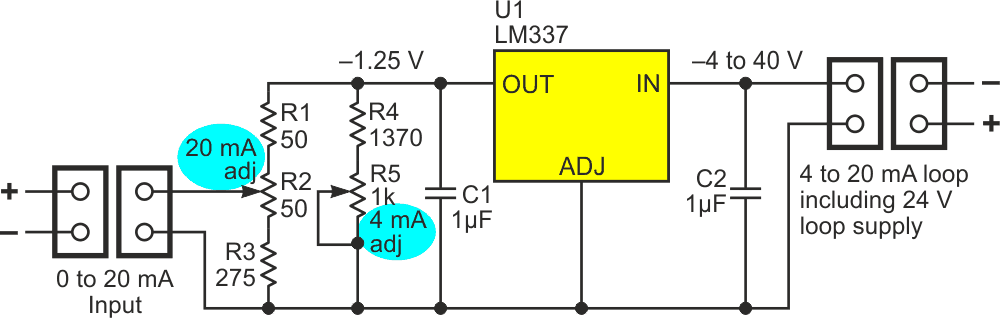
A while back, the design shown in Figure 1 was accepted for publication (Ref. 1).
 |
|
| Figure 1. | U1 plus R1 through R5 current steering networks convert a 0/20 mA input into a 4/20 mA output. |
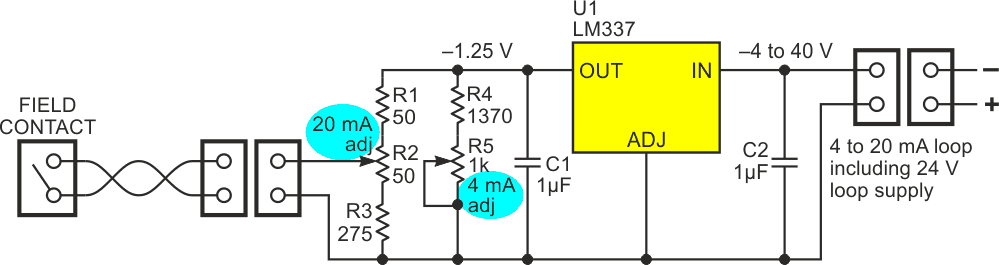
Later, the same circuit, when wired up differently as shown in Figure 2, turned out to be an equally good fit in a different job (Ref. 2).
 |
|
| Figure 2. | This 4/20 mA current loop converter integrates an OFF/ON field contact. |
A recent Design Idea (Ref. 3) by another frequent contributor, Jayapal Ramalingam, addressed the problem of convenient calibration of precision current loop receivers in industrial applications. His design comprises a linear control input that expedites calibration and testing. He explains that it helps to:
…”calibrate the analog input modules of distributed control systems (DCSs) and programmable logic controllers (PLCs) by simulating process signals.”…
This inspired me to wonder if a different approach to the same calibration problem might also be useful. I imagined a design in which the three standard analog test current loop levels: 0, 4 mA, and 20 mA, were accurately preset and quickly accessed by flipping a switch. I then proceeded to ponder whether that same friendly little converter circuit might work in such an application.
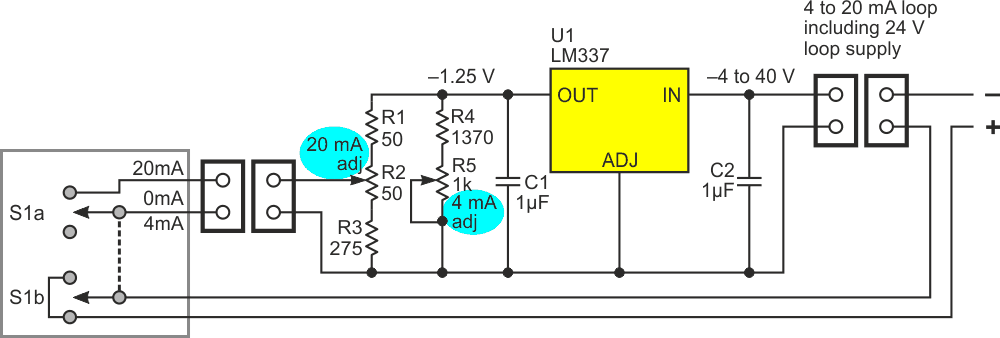
Figure 3 shows the result.
 |
|
| Figure 3. | The three-position, center-off, DPDT switch S1 converts this current converter (verbiage redundancy pun-intentional) into a convenient current calibrator. |
Not only did it fit, but the calibration procedure for the new role is just as quick, simple, and easy to accomplish in a single pass as it was before.
- Set S1 to the 4 mA position.
- Tweak 4 mA adj for 4 mA output (as measured, for example, with a precision DMM).
- Set S1 to the 20 mA position.
- Adjust 20 mA adj for 20 mA output (ditto).
So, it turns out that the same circuit thriftily fits three related, yet different, applications – a triple-duty design trifecta.
References
- Woodward, Stephen. "Silly simple precision 0/20mA to 4/20mA converter."
- Woodward, Stephen. "Double-duty current loop transmitter."
- Ramalingam, Jayapal. "Linearly variable two-wire loop current generator."