With the trend toward miniaturization, temperature effects in power electronics are more pronounced than ever. If you’re dealing with temperature fluctuations in your circuit, you may need a stabilization system to keep the temperature constant and minimize noise in the circuit response.
One approach is to use an optoelectronic circuit with a negative temperature coefficient sensing element and a thermoelectric cooling component. However, a more cost-effective and equally effective solution is to replace certain fixed resistors with temperature-dependent resistors that automatically compensate for temperature variations.
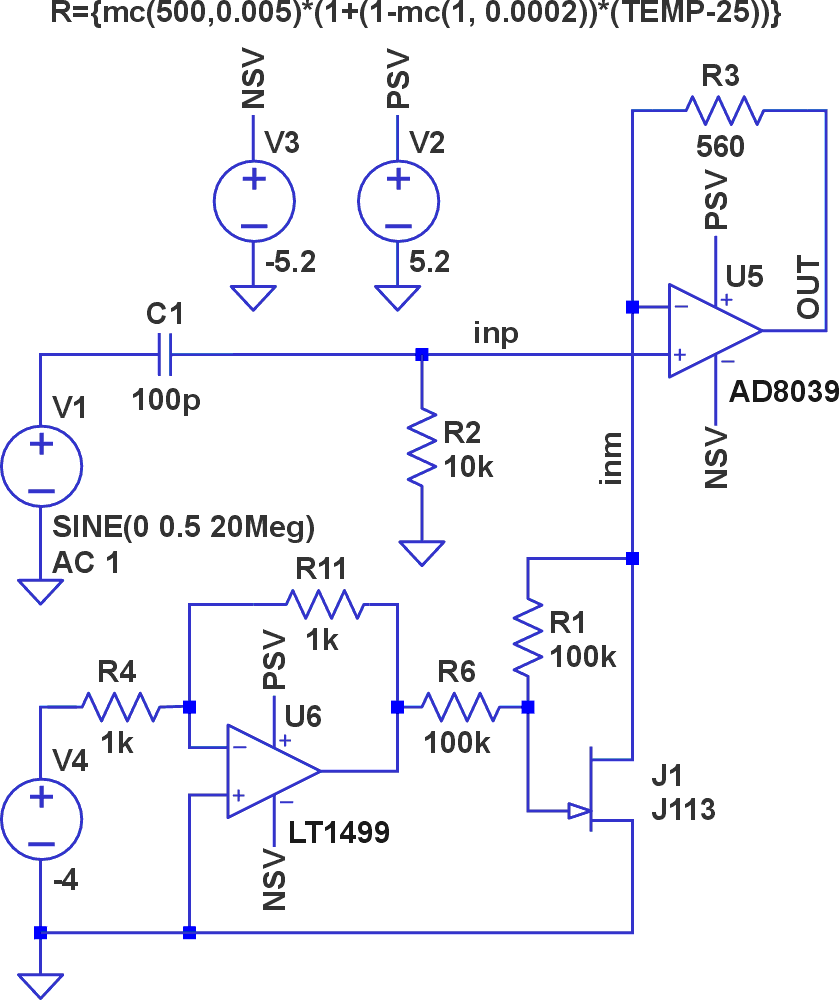
The circuit shown in Figure 1 is a wideband gain amplifier stage built around a JFET transistor. This type of circuit is commonly used to convert a photodiode current into a voltage signal. This configuration enables a linear gain control over a range spanning up to three decades, thanks to the JFET placed in the feedback path of a non-inverting amplifier. onsemi describes this circuit in detail in application note for AN-6603 power MOSFET (Ref. 1).
 |
|
| Figure 1. | The examined circuit (used commonly, for example, to convert a photodiode current into voltage) is a large band gain amplifier stage based on a JFET transistor (J113). This linear control function is achieved with this JFET in the feedback path of a non-inverting amplifier. |
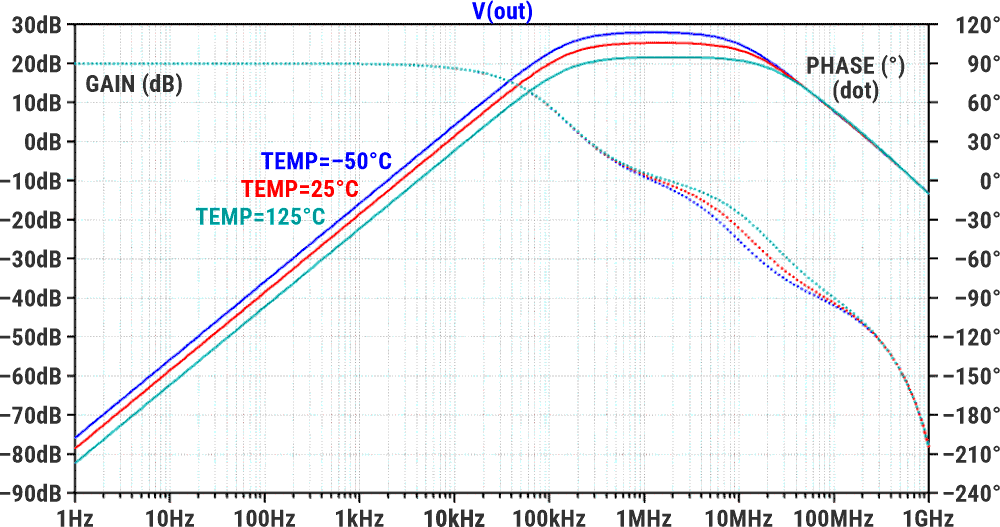
But what about temperature fluctuations? Thanks to the very powerful SPICE simulator LTspice from Analog Devices (Ref. 2), the AC small signal gain frequency (1 Hz up to 1 GHz) analysis of the circuit of Figure 1 is straightforward, and the parasitic temperature effect (from –50 °C up to 125 °C) can be directly represented in Figure 2.
 |
|
| Figure 2. | The cause of gain variation in temperature shown here can be attributed to the BETATCE transconductance temperature coefficients (in %/°C) of the J113 JFET. |
onsemi’s application note acknowledges that the gain of this circuit is temperature-dependent, a result of the JFET’s inherent sensitivity to temperature. The note also briefly mentions that this effect may be mitigated by using a silicon resistor for the feedback resistor R3 – but offers no further guidance. This lack of detail left the author looking for a clearer solution.
Unfortunately, the widely used KTY81 silicon resistor series (a positive temperature coefficient component) has been discontinued as of 2023, and no clear equivalent is currently available – at least, to the author’s knowledge. So, what can be used instead?
One alternative is the surface-mount RTD TFPT0603L5600, an alumina substrate component with nickel-based PTC thin film element having a well-characterized positive temperature coefficient. This component is also RoHS-compliant without exemption.
The root cause of the gain variation shown in Figure 2 lies in the transconductance temperature coefficient (BETATCE, in %/°C) of the J113 JFET, as documented in its SPICE model. Replacing resistor R3 with the Vishay TFPT0603, which has a temperature coefficient of 4110 ± 400 ppm/K, provides a partial correction.
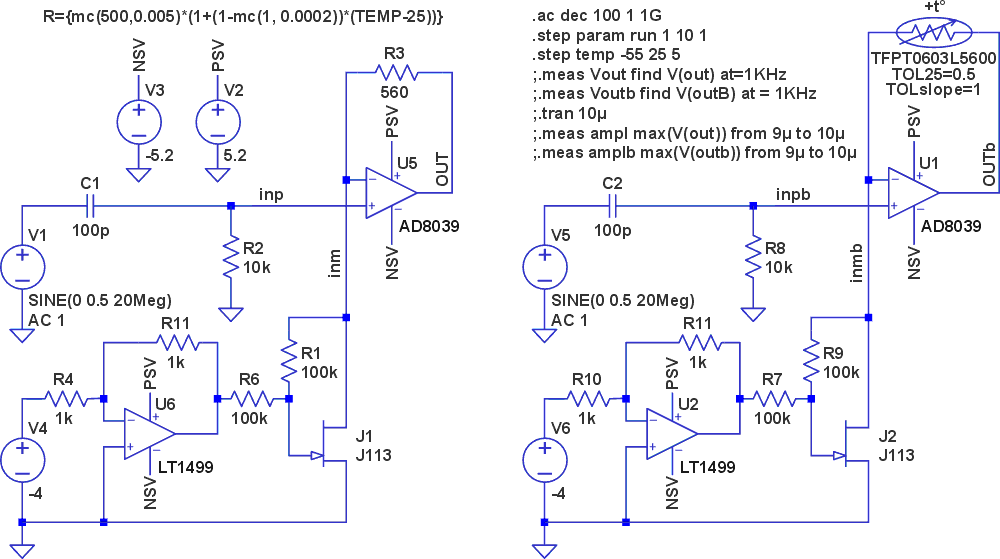
Both versions of the circuit – the original and the one modified with the TFPT – are shown in Figure 3. For simulation accuracy, all relevant tolerances are included: those on the ambient resistance values, on the temperature coefficient of the fixed resistor, and on the TFPT itself. The simulations randomly vary these parameters. To ensure a fair comparison, the ambient resistance tolerance for both the fixed resistor and the TFPT is set to ± 0.5%.
 |
|
| Figure 3. | The diagram shows the original (left) and modified (right) versions of the large band gain amplifier stage circuit. |
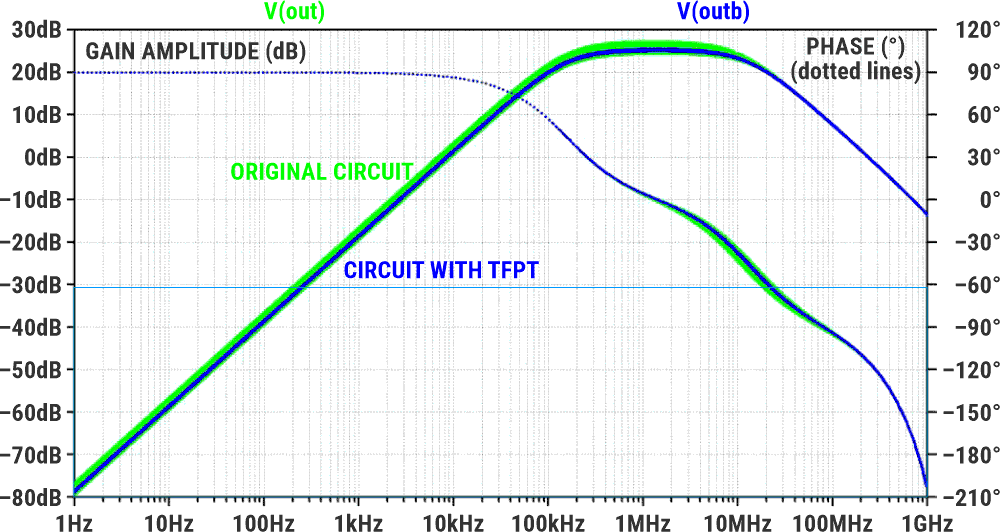
The Figure 4 demonstrates a substantial improvement in temperature stability with the compensated TFPT0603 version.
 |
|
| Figure 4. | The blue curves (representing the circuit with the TFPT0603) show a significant reduction in temperature-induced noise in both gain amplitude and phase compared to the green curves (representing the original circuit with a fixed resistor). |
Thus, a simple circuit modification can effectively reduce temperature-induced noise and enhance overall system stability at a reasonable cost.