This design based on an SR latch and two RC networks is, unlike many alternative solutions, neither complex nor expensive.
Single and differential capacitance sensors are widely used to measure linear and angle displacement, pressure, proximity, humidity, fluid level, inclination and acceleration. Both analog and digital circuits are used to interface the sensors (References 1-4). Some of the solutions tend to be complex and expensive (References 5-9).
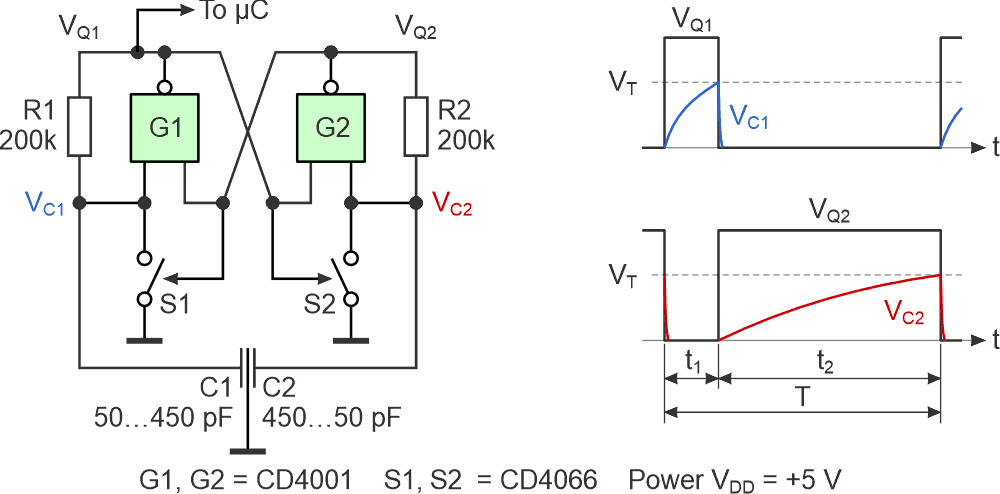
This Design Idea presents a very simple circuit to interface differential capacitance sensors (Figure 1). It is a relaxation oscillator made of an SR latch and two RC networks. When one of the capacitors is gradually charged through the corresponding resistor, the other capacitor is quickly discharged through a parallel switch. When the charging capacitor reaches the trip voltage VT of its gate, the latch changes its state. The other capacitor starts charging and the first one is quickly discharged. When the second charging capacitor reaches the trip level VT of its gate, the latch flips again returning to the initial state. The charge-discharge process repeats over and over again.
 |
|
| Figure 1. | The sensor becomes part of a relaxation oscillator where one of the capacitors is charging when the other one is shorted; the two capacitors periodically swap their operation. |
Signal VQ1 goes to a microcontroller, which measures time intervals t1 and t2 and calculates the average value
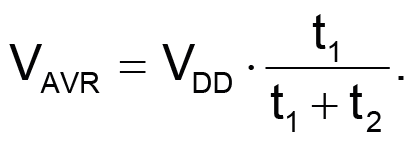
A number needs to be subtracted from this value so when the two capacitors are equal the average value is zero. Thus, the average value will be positive when C1 > C2 and negative when C1 < C2.
 |
|
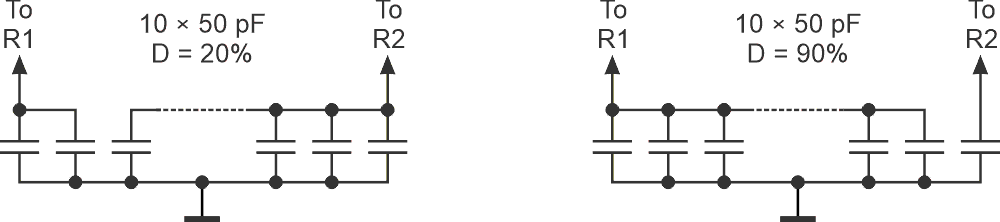
| Figure 2. | Sensor operation is simulated with a bank of 10 capacitors. |
Circuit operation was tested with a bank of ten 50-pF capacitors. The left side of Figure 2 shows connections to set a duty cycle of 20%; the right side of the figure sets the duty cycle of 90%.
 |
|
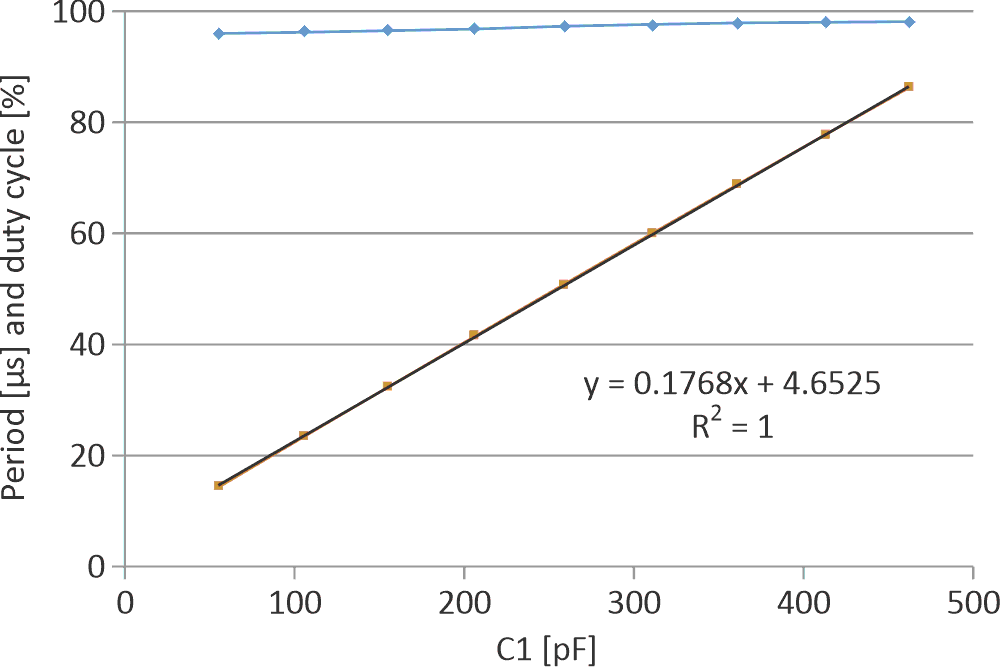
| Figure 3. | Circuit responses: at the top, the period is almost the same, below it, the duty cycle depends linearly on the value of C1. |
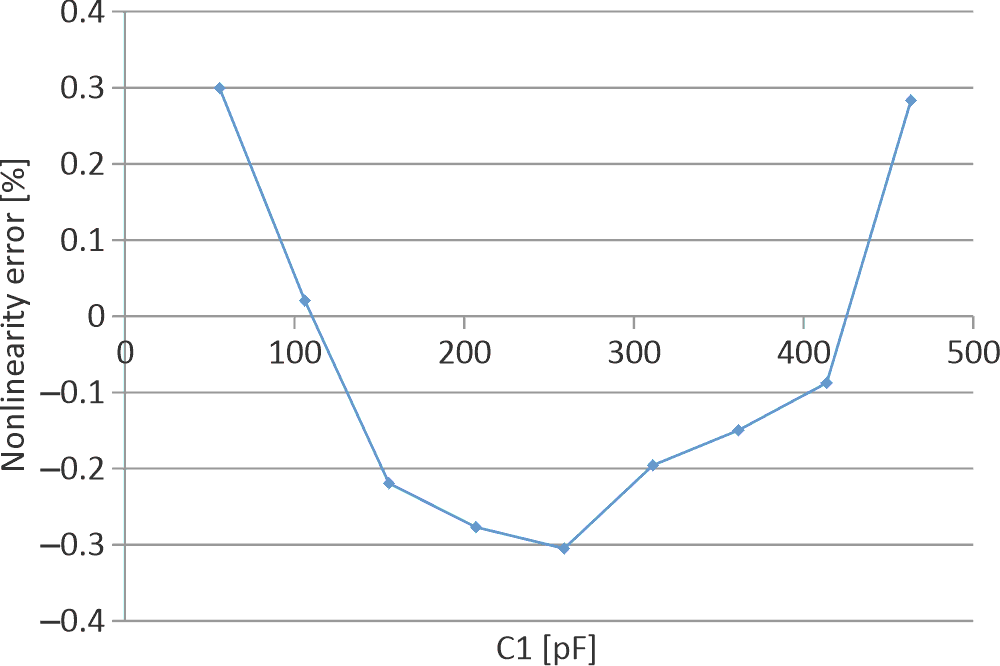
Figure 3 presents how period T and duty cycle D = t1/T depend on the value of C1. Period barely changes between 96 and 98 µs, while the duty cycle is proportional to C1. A straight line fits perfectly the duty cycle data (the R2 factor equals 1); however, as Figure 4 shows, the line has a nonlinearity error of ±0.3%.
 |
|
| Figure 4. | The duty cycle response has a nonlinearity error of ±0.3 %. |
The bump shape of the error graph means that a second-order polynomial may improve linearity. Indeed, equation
y = 1 × 10⁻⁵ × x2 + 0.182 × x + 4.21
reduces the error down to ±0.1%. Such an equation is easy to implement in the microcontroller firmware.
References
- Regtien P., E. Dertien. Sensors for mechatronics. 2nd ed., Ch. 5, Elsevier, 2018.
- Northrop R. B. Introduction to instrumentation and measurement. 3rd ed., CRC Press, 2014.
- Baxter L. Capacitive sensors.
- Differential capacitance pressure sensor circuit.
- Reverter F., O. Casas. Direct interface circuit for differential capacitive sensors. I2MTC 2008 – IEEE International Instrumentation and Measurement Technology Conference, Victoria, Vancouver Island, Canada, May 12-15, 2008.
- Barile G. et al. Linear integrated interface for automatic differential capacitive sensing. Proceedings 2017, 1, 592.
- Ferri G. et al. Automatic bridge-based interface for differential capacitive full sensing. 30th Eurosensors Conference, EUROSENSORS 2016. Procedia Engineering 168 (2016) 1585 – 1588.
- Bai Y. et al. Absolute position sensing based on a robust differential capacitive sensor with a grounded shield window. Sensors (Basel). 2016 May; 16(5): 680.
- De Marcellis A., C. Reig, M. Cubells-Beltrán. A capacitance-to-time converter-based electronic interface for differential capacitive sensors. MDPI Electronics, Jan 2019.