DAC control (via PWM or other source) of regulators is a popular design topic here in editor Aalyia Shaukat’s Design Ideas (DIs) corner. There’s even a special aspect of this subject that frequently provokes enthusiastic and controversial (even contentious) exchanges of opinion.
It’s the many and varied possibilities for integrating the regulator’s internal voltage reference into the design. The discussion tends to be extra energetic (and the resulting circuitry complex) when the design includes generating output voltages lower than the regulator’s internal reference.
What can be done to make the discussion less complicated (and heated)?
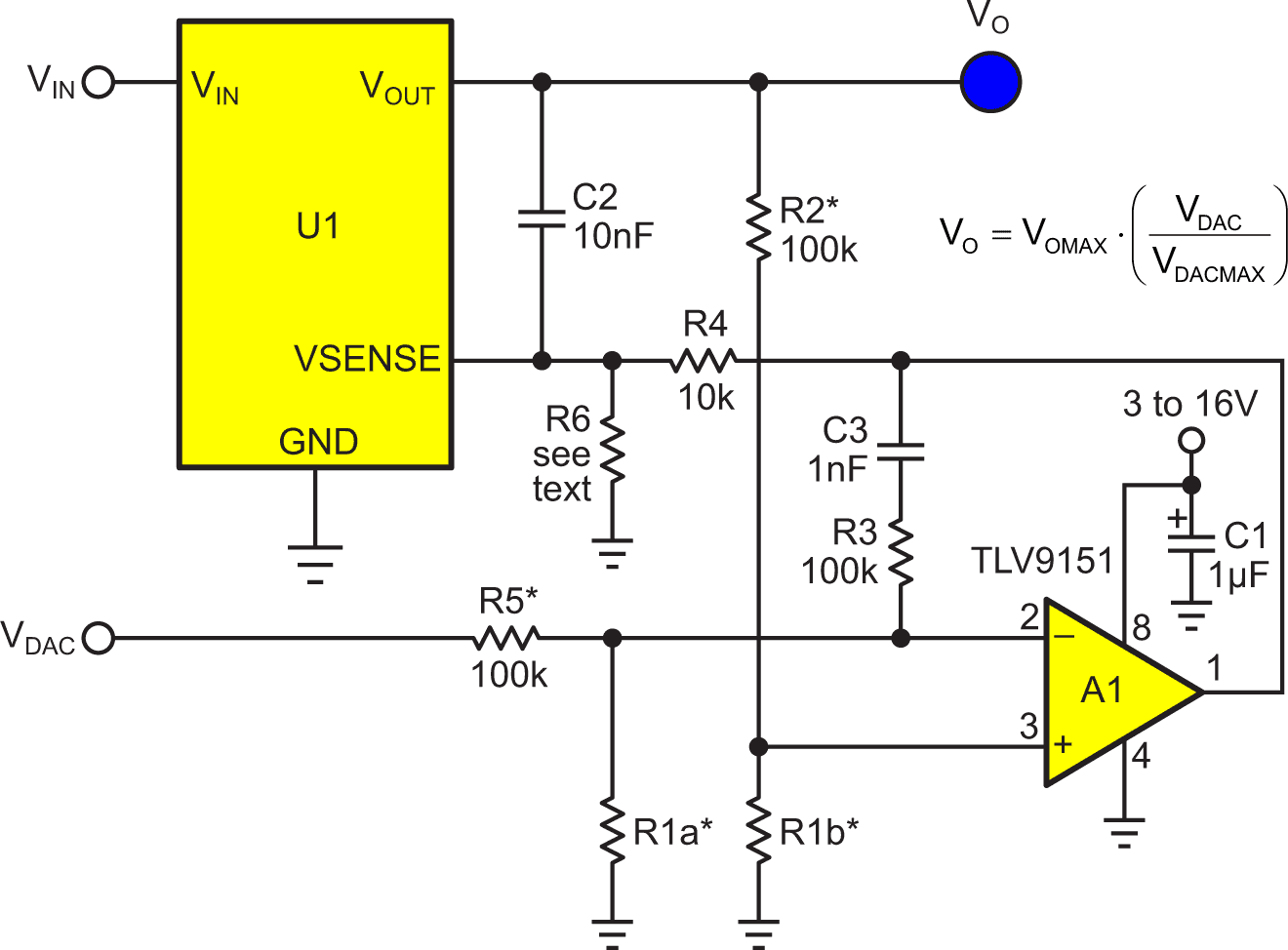
An old rule of thumb suggests that when one facet of a problem makes the solution complex, sometimes a simple (and better) solution can be found by just ignoring that facet. So, I decided, just for fun, to give it a try with the regulator reference problem. Figure 1 shows the result.
 |
|
| Figure 1. | DAC control of a regulator while ignoring its internal voltage reference. |
Figure 1’s simple theory of operation revolves around the A1 differential amplifier.
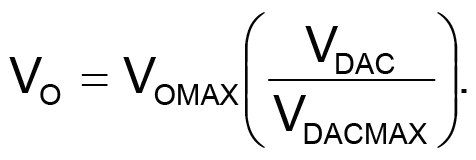
If VDACMAX >= VOMAX then
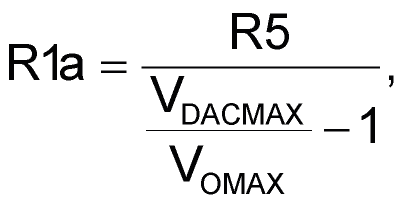
omit R1b.
If VOMAX >= VDACMAX then
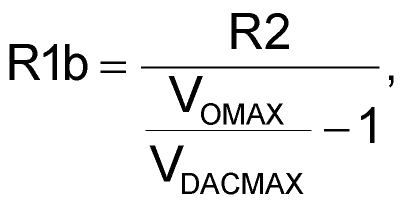
omit R1a.
A1 subtracts (suitably attenuated versions) of the control input signal (VDAC) from U1’s output voltage (VO) and integrates the difference in the R3C3 feedback pair. The resulting negative feedback supplied to U1’s VSENSE pin is independent of the VSENSE voltage and is therefore independent of U1’s internal reference.
With the contribution of accuracy (and inaccuracy) from U1’s internal reference thus removed, the problem of integrating it into the design is therefore likewise removed.
Turns out the potential for really good precision is actually improved by ignoring the regulator reference, because they’re seldom better than 1% anyway.
With the Figure 1 circuit, accuracy is ultimately limited only by the DAC and very high precision DACs can be assembled at reasonable cost. For an example see, “A nice, simple, and reasonably accurate PWM-driven 16-bit DAC” (Ref. 1).
Another nice feature is that Figure 1 leaks no pesky bias current into the feedback network. This bias is typically scores of microamps and can prevent the output from getting any closer than tens of millivolts to a true zero when the output load is light. No such problem exists here, unless picoamps count (hint: they don’t).
And did I mention it’s simple?
Oh yeah. About R6, depending on the voltage supplied to A1’s pin 8 and the absmax rating of U1’s VSENSE pin, the possibility of an overvoltage might exist. If so, adjust the R4R6 ratio to prevent that. Otherwise, omit R6.
Reference
- Paul, Christopher . "A nice, simple, and reasonably accurate PWM-driven 16-bit DAC."