A recent Design Idea (DI), “Silly simple precision 0/20 mA to 4/20 mA converter,” (Ref. 1) by prolific DI contributor Stephen Woodward uses the venerable LM337 regulator in a creative configuration along with a few passive components, to translate an input 0-20 mA current source (say from a sensor with a separate power source that outputs a 0-20 mA signal current) into a 4-20 mA two-wire transmitter current loop (a standard 2 terminal industrial current source).
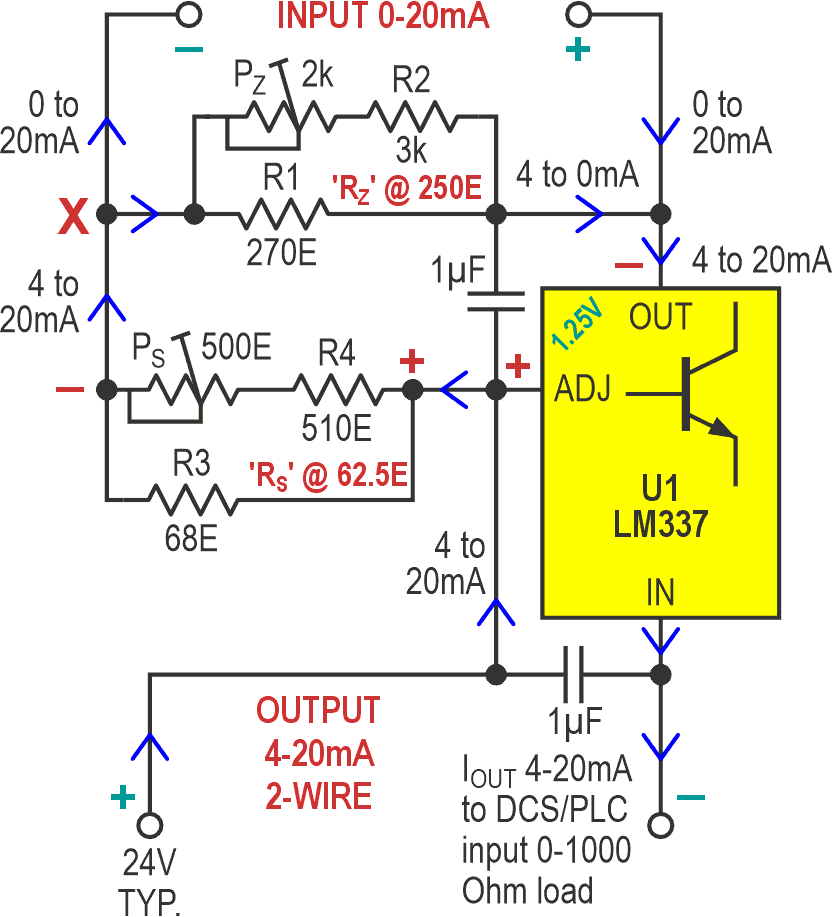
Below is another novel, ‘silly simple’ way of implementing the same function using the LM337. It relies on tapering off an initial 4 mA current to zero in proportion to the input 0-20 mA, and adding the input and the tapered off 4 mA signal to create a 2-wire 4-20 mA output loop. It is loosely based on another Woodward gem [2]. Refer to Figure 1.
 |
|
| Figure 1. | An input 0-20 mA is added to a tapered-off 4-0 mA at OUT to give an output 4-20 mA. |
First, imagine ‘0 mA’ current input (input loop open). The series arrangement of R1 parallel ‘R2 + PZ’ (‘RZ’@250E) and R3 parallel ‘R4 + PS’ (‘RS’@62.5E) having a nominal value of 312.5E, sets the value of output loop current into OUT at 0 mA + 4 mA (1.25 V/312.5E), set using PZ.
Now, feeding a 20 mA input current, imagine it pulled from junction X and pushed into the OUT terminal. This current is sourced from the output loop ‘+’, dropping 62.5E × 20 mA = 1.25 V in RS, in a direction opposing the internal reference voltage. With proper calibration, this reduces the drop across RZ to zero, and in doing so, reduces the original 4 mA contribution through RZ into OUT, also to zero.
The output loop current is now equal to the input current of 20 mA + 0 mA (added at OUT), transferred from the input loop to the output loop from OUT to IN of U1. We have converted a current source input of 0-20 mA to a 2-wire loop current of 4-20 mA. The 20 mA setting is done by PS.
Accurate current setting requires 2 S/Z passes to set the output current to within 0.05% or (much) better. Pots should be multi turn 3296 types or similar, but single turn trimmers will also work fairly well as both pots have a small trim range, by design.
The performance is excellent. The input to output linearity of the basic circuit is 0.02%. With a small heat sink, short term stability is within 0.02%, and change in loop current is 0.05% over a voltage from 5 V to 32 V. Transfer accuracy and stability are high because we aren’t transforming the input signal, only transferring it into the output loop. Reference drift affects only the basic 4 mA current and thus has a smaller effect on overall drift. The heat sink improves drift and di/dv by a factor of 3 to 4.
For intermediate input currents, the 4 mA basic current via RZ into OUT is tapered off in proportion to the input 0-20 mA current. Thus at 10 mA (half) input current, the voltage at X changes suitably to maintain @500 mV across RZ, this supporting a contribution of 2 mA into OUT, down from the original 4 mA set at 0 mA input current. Output loop current into OUT is now the input 10 mA + 2 mA = 12 mA, the halfway point of the 4-20 mA loop too. Similar reasoning applies to other input/output loop currents relationships.
A reverse protection diode is recommended in the 4-20 mA loop. Current limiting should be applied to limit fault current to safe levels. A series 2-transistor current limiter with appropriate resistance values is an excellent candidate, being low drop, low cost, fast acting and free from oscillation. A 40-mA ptc ‘polyfuse’ in the loop will protect the load from a complete short across both circuits (an unlikely event).
The basic drop seen by the 0-20 mA signal is –1 V to 0 V. Two diodes or an LED in series with the + of the 0-20-mA input allow the source to always see a positive drop.
Regarding stability: only the 68E(R3) and the 270E(R1) need to be 25 ppm 1% types to give low overall temperature drift, which is a significant plus. Pot drift, typically larger than that of fixed resistors, has less effect in the configuration used, wherein pots PS and PZ, relatively high valued, control only a small part of the main current. Larger pot values also help minimize the effect of varying pot contact resistance.
A 3-V minimum operating voltage allows as much as 1000E of loop resistance with a 24-V supply, for the basic circuit.
It is a given that one of the loops will (need to) be floating. This is usually the source loop, as the instrument generating the 0-20 mA is powered from a separate supply.
Reference
- Woodward, Stephen. "Silly simple precision 0/20mA to 4/20mA converter."
- Woodward, Stephen. "PWM-programmed LM317 constant current source."