This Design Idea (DI) offers an alternative solution for an application borrowed from frequent DI contributor R. Jayapal, presented in: “A 0-20 mA source current to 4-20 mA loop current converter” (Ref. 1).
It converts a 0/20 mA current mode input, such as produced by some process control instrumentation, into a standard industrial 4/20 mA current loop output.
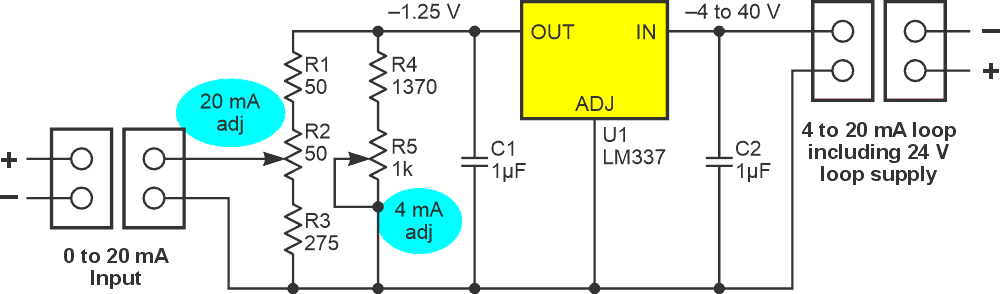
Figure 1 shows the circuit. It’s based on a (very) old friend – the LM337 three-legged regulator. Here’s how it works.
 |
|
| Figure 1. | U1 plus R1 through R5 current steering networks convert 0/20 mA input to 4/20 mA output. |
The fixed resistance of the R1 + R2 + R3 series network, working in parallel with the adjustable R4 + R5 pair, presents a combined load of 312 ohms to the 1.25 V output of U1. That causes a zero-input current draw of 1.25/312 = 4 mA, trimmed by R5 (see calibration sequence detailed later).
Summed with this is a 0 to 16 mA current derived from the 0 to 20 mA input, controlled by the 4:1 ratio current split provided by the R1/R2/R3 current divider and fine trimmed by R2 (ditto).
Note that 4 mA is below the guaranteed minimum regulation current specification for the LM337. In fact, most will work happily with half that much, but you might get a greedy one. So just be aware.
The result is a precision conversion of the 0 to 20 mA input to an accurate 4 to 20 mA loop current. Conversion precision and stability are insensitive to R2 trimmer wiper resistance due to the somewhat unusual input topology in play.
Calibration proceeds in a four-step linear (iteration-free one-pass) sequence consisting of:
- Set input = 0.0 mA.
- Adjust R5 for 4.00 mA loop current.
- Set input = 20.00 mA.
- Adjust R2 for 20.00 mA loop current.
Done.
The input voltage burden is a negative 1.0 volt. The output loop voltage drop is 4 volts minimum to 40 volts maximum. The maximum ambient temperature (with no U1 heatsink) is 100 °C. Resistors should be precision types, and the trimmer pots should be multiturn cermet or similar.
Reference
- Ramalingam, Jayapal. "A 0-20mA source current to 4-20mA loop current converter."