A topic that has recently drawn a lot of interest (!) and no fewer than four separate design articles (!!) here in Design Ideas, is the conversion of 0 to 20 mA current sources into industrial standard 4 mA to 20 mA current loop signals. Here’s the list – so far – in reverse chronological order. Apologies if (as is quite possible) I’ve missed one – or N.
- Another silly simple precision 0/20 mA to 4/20 mA converter [1].
- Silly simple precision 0/20 mA to 4/20 mA converter [2].
- Combine two TL431 regulators to make versatile current mirror [3].
- A 0-20 mA source current to 4-20 mA loop current converter [4].
With so much energy already devoted to that one side of this well-tossed coin, it seemed only fair to pay a little attention to the flip side of the conversion function coin.
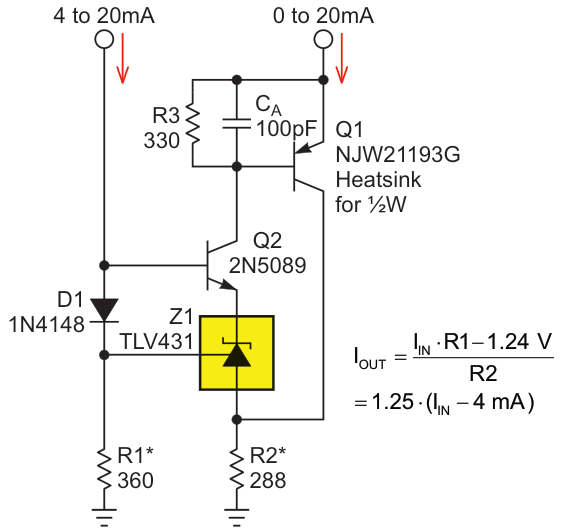
Figure 1 shows the result. Its (fairly) simple circuit performs a precision conversion from 4-20 mA to 0-20 mA. Here’s how it works.
 |
|
| Figure 1. | The flip side of the current conversion coin. |
The core of the circuit is the VIN = IIN·R1 = 1.24 V to 7.20 V developed by the 4-20 mA input working into R1 and sensed by the VREF input of Z1. The principle in play is discussed in Figure 1 of “Precision programmable current sink” [5].
The resulting Z1 cathode current is
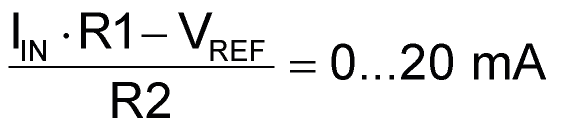
as IIN increases from 4 mA to 20 mA. Or it would be if not for the phenomenon of VREF modulation by Z1 cathode voltage. The D1, Q2 cascode pair greatly attenuates this effect by holding Z1’s cathode voltage near zero and constant. It also extends Z1’s cathode voltage limit from an inadequate 7 V to the 30 V capability of Q2. Of course, a different choice for Q2 could extend it further. But if 30 V will do, the >1000 typical beta of the 5089 is good for accuracy.
Current booster Q1 extends Z1’s 15 mA max current limit while also reducing thermal effects. The net result holds Z1’s maximum power dissipation to single-digit milliwatts.
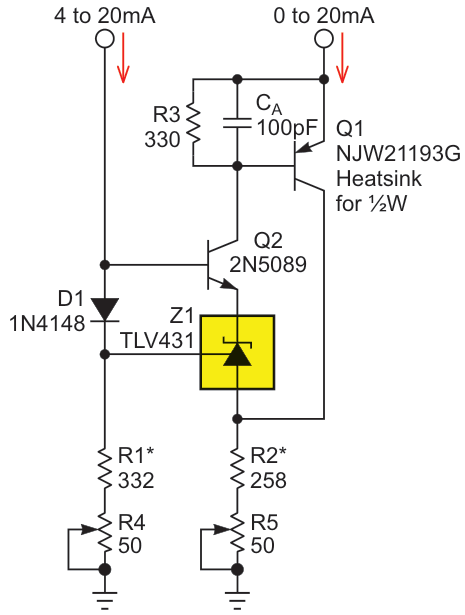
With 0.1% precision R1 and R2 and the ±0.5% tolerance TLV431B, better than 1% accuracy can be achieved with the untrimmed Figure 1 circuit. If this level of precision is still inadequate, manual post-assembly trim can be added with just two extra parts, as shown in Figure 2. Calibration is achieved with one pass.
- Set input current to 4.00 mA
- Adjust R4 for output current of ~50 µA. Note this is only 0.25% of full-scale, so don’t worry about hitting it exactly. You probably won’t.
- Set input current to 20 mA
- Adjust R3 for an output current of 20 mA
Input max overhead voltage is 8 V, output overhead is 9 V. Worst case (resistor limited) fault current with 24 V supply = 80 mA.
Readers may notice a capacitor labeled “CA” in Figures 1 and 2. This is the “Ashu capacitance” that Design Idea (DI) contributor and current source circuitry expert Ashutosh Sapre discovered to be essential for frequency stability of the cascode topology. Thanks, Ashu!
 |
|
| Figure 2. | R4 and R5 trims allow post-assembly precision optimization. |
And a closing note. Since the output scale factor is set by and inversely proportional to R2, if any full-scale other than 20 mA is desired, it’s easily achieved by an appropriate choice for R2.
References
- Sapre, Ashutosh. "Another silly simple precision 0/20 mA to 4/20 mA converter."
- Woodward, Stephen. "Silly simple precision 0/20 mA to 4/20 mA converter."
- Woodward, Stephen. "Combine two TL431 regulators to make versatile current mirror."
- Ramalingam, Jayapal. "A 0-20mA source current to 4-20 mA loop current converter."
- Woodward, Stephen. "Precision programmable current sink."