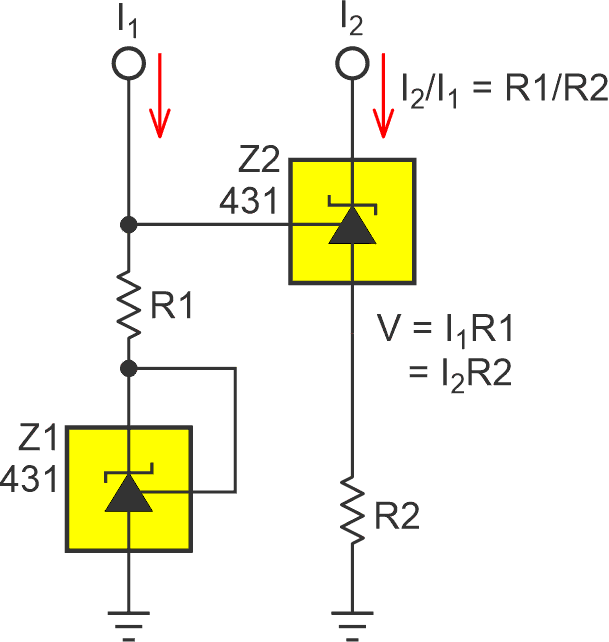
Various designs for current mirror circuits have been an active topic recently here in Design Ideas (DIs). Usually, the mirror designer’s aim is to make the mirror’s input and output currents accurately equal, but Figure 1 shows one that takes a tangent. Being immune to traditional current mirror bugaboos (Early effect, etc.), it can achieve the equality criterion quite well, but it also has particular versatility in applications where the input and output currents deliberately differ.
 |
|
| Figure 1. | The R1/R2 resistance ratio sets the I2/I1 current ratio. |
Here’s the backstory: Awhile back, I published a DI that used the venerable family of TLx431 shunt voltage regulators as programmable current regulators: “Precision programmable current sink” (Ref. 1).
Figure 1 demonstrates their versatility again, this time combining two of the beasties to make a programmable gain current mirror.
The choice between the 2.5-V reference voltage TL431 and the 1.24-V TLV431 can be based on their different current and voltage ratings. For current: 1 mA to 100 mA for the TL versus 100 µA to 15 mA for the TLV. For voltage: 2.5 V to 36 V for the TL versus 1.24 V to 6 V for the TLV.
Note that both I1 and I2 must fall within those respective current numbers for useful regulation (and reflection!) to occur. Minimum mirror input voltage = VREF + I2R2.
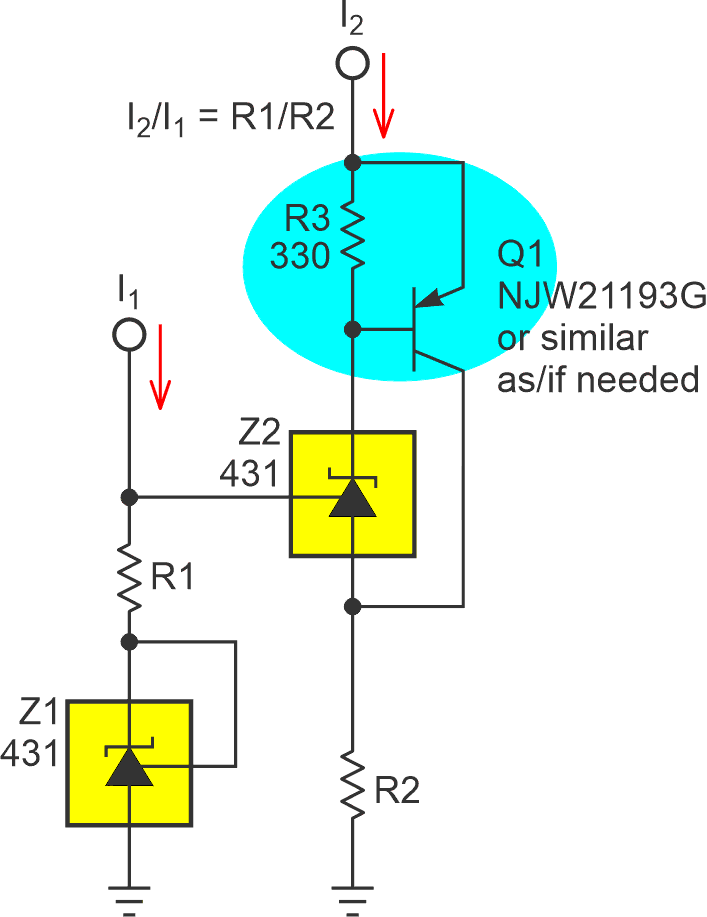
Of course, you must also accommodate the modest heat dissipation limits of these small devices. However, the maximum current (and power) capabilities can be extended virtually without limit by the simple ploy shown in Figure 2.
 |
|
| Figure 2. | Booster transistor Q1 can handle current and power beyond 431 max IC and dissipation limits. |
And one more thing.
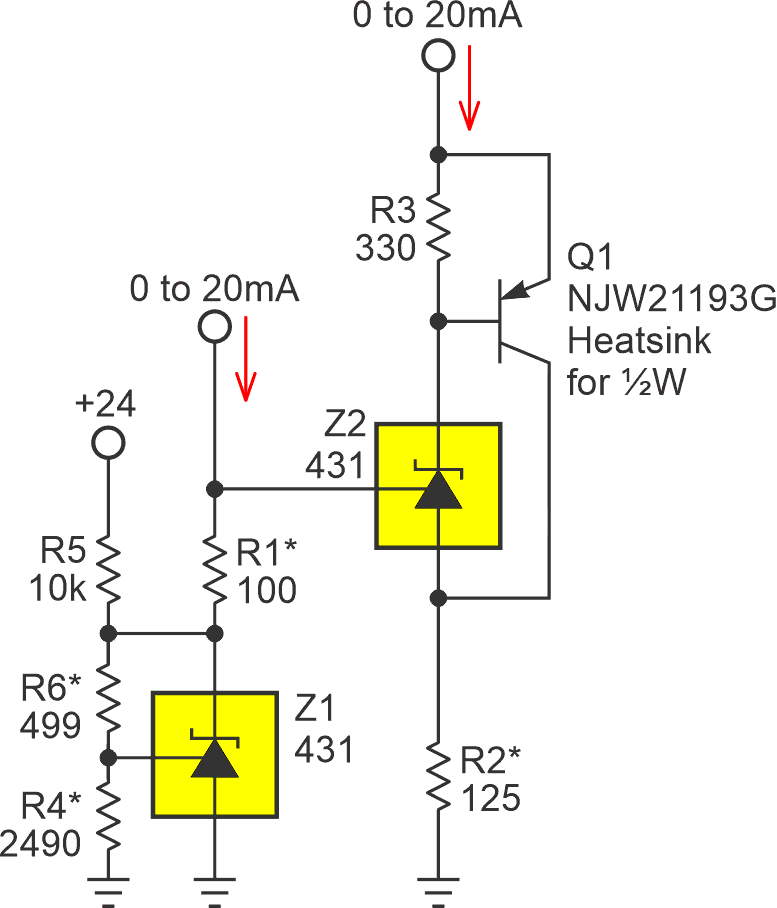
You might reasonably accuse Z1 of basically loafing since its only job is to provide bias voltage for R1 and Z2. But we can give it more interesting work to do with the trick shown in Figure 3. Not only can this scheme accommodate arbitrary I1/I2 ratios, but we can also add a fixed offset current! Here’s how.
 |
|
| Figure 3. | Add six resistors and one transistor to two TL431s to make this 0/20 mA to 4/20 mA current loop converter. Z2 sums the 500-mV offset provided by Z1 with the 0 to 2 V made by current sensor R1, then scales that with R2 to output the 4 to 20 mA with a boost from Q1 that can accommodate loop voltages up to 36 V. Note R1, R2, R4, and R6 need to be precision types. |
What results here is a (somewhat simpler) solution to an application borrowed from a previous DI by frequent contributor R Jayapal in: “A 0-20mA source current to 4-20mA loop current converter” (Ref. 2).
References
- Precision programmable current sink
- Ramalingam, Jayapal. "A 0-20mA source current to 4-20mA loop current converter."