Ordinary bipolar junction transistors can sometimes be precision sensors.
When you think of precision components, you usually don’t (and probably shouldn’t) think of general-purpose bipolar junction transistors. Are GP BJTs cheap and versatile? Unquestionably yes. But are their characteristics, current gain, bias voltage, etc., precise and predictable to a fraction of a percent? Sadly (and maybe even laughably) no. But not entirely so. A dramatic exception is the ΔVBE effect, in which ordinary small signal BJTs can function in simple circuits as 0.1% precision absolute temperature sensors, as shown in an earlier Design Idea (Ref. 1).
The ΔVbe effect depends solely on the ratio of applied currents, independent of their absolute magnitudes. It has an amplitude of 1/5050 volts per Kelvin and 1/9090 volts per Rankine per current ratio decade. Figure 1 shows how this simple math can be exploited to turn most any 3¾ digital multimeter with a 300 mV range into a versatile and accurate 0.1° resolution thermometer switchable between Celsius and Fahrentheit scales.
 |
|
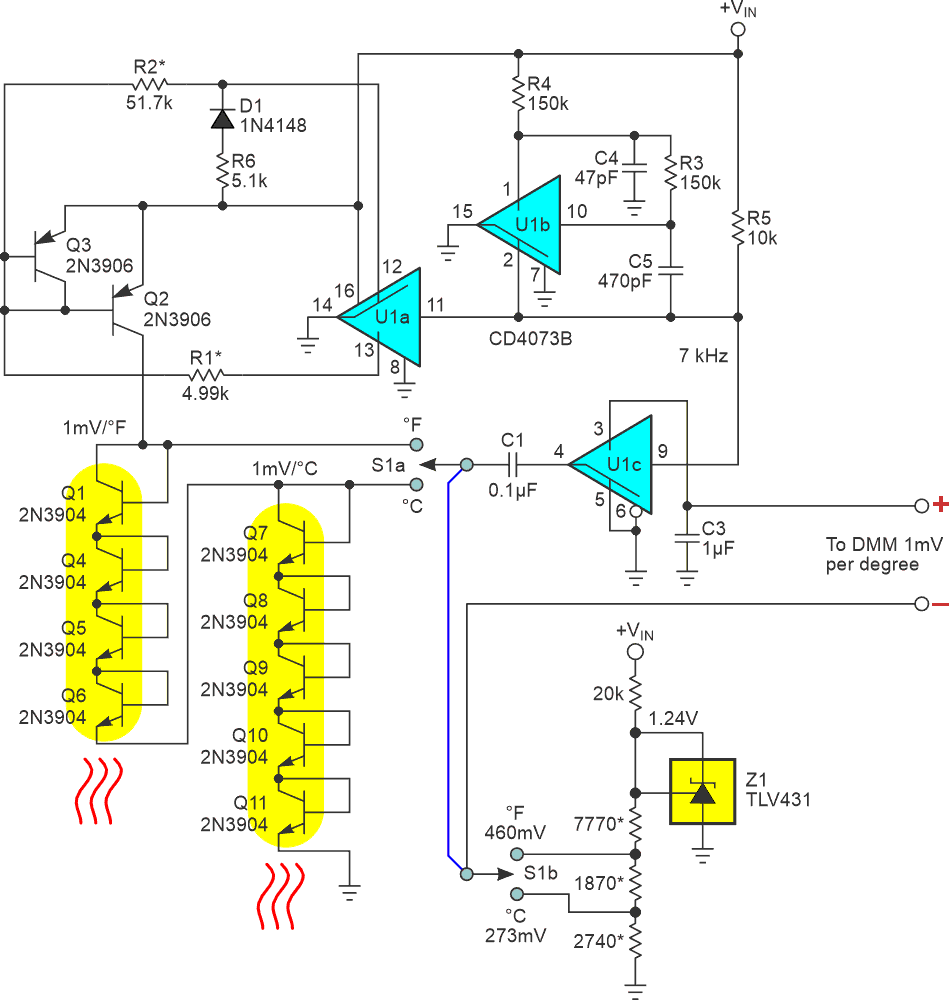
| Figure 1. | Switch U1a and current mirror Q2Q3 apply an excitation current ratio of 10.23:1 to the 9-sensor transistor string. The string is tapped at 5 × 200 µV/°C = 1 mV/°C and 9 × 111 µV/°F = 1 mV/°F. |
Here’s how it works. Multivibrator U1b and switch U1a drive current mirror Q2Q3 with a square wave current signal. Its two states have a precise ratio of 101.01 = 10.23:1. The current mirror applies this signal to the 9-transistor temperature sensing string. There, the ΔVBE effect causes each transistor to develop 200 µV per Kelvin and 111 µV per Rankine, summing to 1 mV/°K at the 5-transistor tap and 1 mV/°R at the 9-transistor tap.
The S1a section of the DPDT switch S1 allows appropriate tap selection for the desired temperature scale. Meanwhile, the S1b section selects the appropriate Z1 derived 0° offset: 273 mV for Celsius and 460 mV for Fahrenheit. The D1R6 dummy load balances the currents passed by the two sides of the U1a switch, equalizing its RON voltage losses. Current mirror lovers will no doubt notice that the Q2Q3 mirror, consisting as it does of unmatched transistors with no emitter degeneration, probably lacks an accurate gain ratio. But that’s okay. It doesn’t need one.
Remember that the ΔVBE effect depends solely on the ratio of applied currents and is unaffected by of their absolute magnitudes. So the mirror’s gain can vary over a wide range without significantly affecting temperature measurement accuracy. V+ can likewise wander harmlessly from 7 to 20 volts. A simple 9 volt battery will therefore work well and, since the total current draw is less than 2 mA, will last for hundreds of hours of continuous operation.
Multivibrator U1b provides asymmetrical ~7 kHz timing for synchronous sensor excitation and precision AC signal rectification by U1c. Asterisked resistors should be ±0.1% precision types to preserve accuracy.
Yes. Those ordinary dime-a-throw GP BJTs are really that good.
Reference
- Woodward, Stephen. "BJT is accurate sensor for absolute temperature in Kelvin and Rankine."