Some folks prefer pushbutton switches to take effect on push instead of release. These buttons do that very thing.
I suppose it’s really just a matter of taste, but I’ve always liked momentary contact switches that act when you push them better than those that wait until you let go. It’s really an arbitrary thing, so I wouldn’t presume to criticize designs that choose the latter over the former, like this one (Ref. 1) from one of my favorite Design Idea contributors.
It’s not worse. Or better, for that matter. Just different.
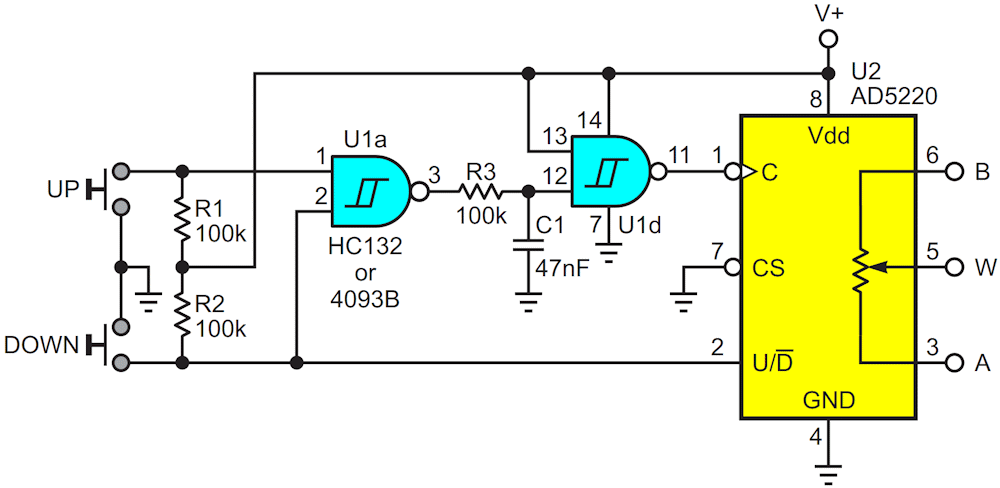
In contrast to Jayapal Ramalingam’s design, Figure 1’s circuit implements my preferred method. It bumps DPOT U2’s setting by one count each time the UP button is pressed, and un-bumps it when DOWN is mashed.
 |
|
| Figure 1. | This pushbutton-to-digital-potentiometer interface is optimal for impatient people. |
Here’s how it works.
Pushing either button makes U1a’s pin 3 go high. Contact bounce is filtered out by R3C1’s ~5 ms time constant, and Schmidt trigger inverter U1d then delivers a single clean low-going transition to U2’s clock input. This makes U2’s wiper take one step up if its pin 2 is high (i.e., the UP button is pressed and DOWN isn’t) or one step down if pin 2 is low (i.e., DOWN is down).
Other than that difference, there’s really no compelling reason to choose Figure 1 over RJ’s circuit. Figure 1’s parts count does include one fewer chip, but so what? They’re cheap.
But stay tuned for future developments that go-when-pushed makes possible, which might be more significant…
Reference
- Ramalingam, Jayapal. "Push to increase, decrease a digital potentiometer."