Courtesy of this circuit’s flexibliity, you can select and adjust both, one, or none of the channels of a dual digipot.
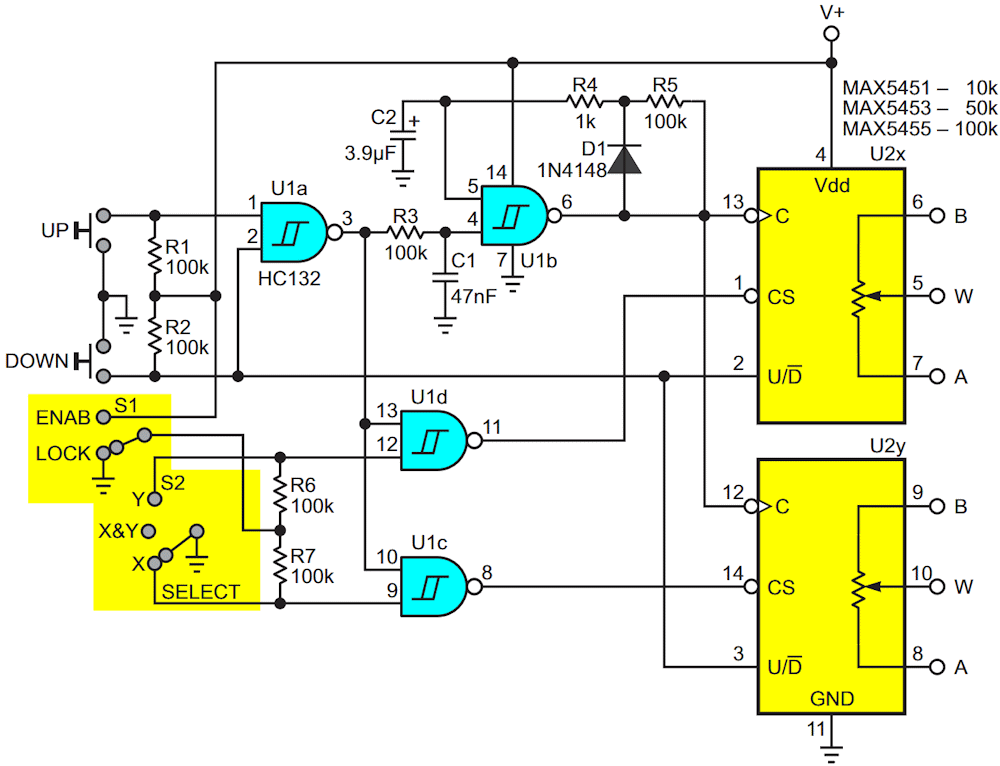
One huge advantage that digital potentiometers have over electromechanicals is, of course, the inherent flexibility the electronic interface provides versus the mechanical alternative. Figure 1 shows an example.
 |
|
| Figure 1. | The 256-step (8-bit) resolution, dual-channel DPOT U2 can be programmed up/down with single step-per-push or auto-repeat (button held), with operating mode options including channel X or Y alone per switch S2’s position on X or Y, both ganged together with S2 in X&Y, or setting-protected (where accidental button pushing won’t disturb the setting) with S1 in LOCK. |
Dual tandem pots have certainly existed for a very long time, and are sometimes extremely useful. Adjusting the volume on a stereo sound system, or tuning a two-pole filter, are obvious examples. But when mechanical pots share a common shaft, of course, they must turn in lockstep together forever, whether that suits the application at hand perfectly. Or not.
Figure 1’s circuit allows U2’s dual pots to step together, singly, or not at all as determined by simple switches S1 (SPST) and S2 (SPDT three position with center off). Convenient autorepeat is accessed by holding the desired step UP/DOWN button depressed for longer than a half second.
Which is certainly a step up in flexibility.