A predominant failure mechanism for production pc boards is shorted traces. Finding hidden shorts is often time-consuming and frustrating. Typical techniques of cutting traces, lifting pads, and “blowing” shorts are, at best, questionable because they may affect the reliability of the circuit, and the ever-decreasing geometries and lower voltage ICs make these practices tricky and risky. High-end, four-wire DMMs (digital multimeters) or ohmmeters, which can accurately measure the small resistance values, are expensive and sometimes not available on a designer's bench.
An inexpensive alternative approach for finding short circuits, using the concepts of four-wire DMMs and ohmmeters is simple and requires only the tools you already have on your bench and a basic understanding of Ohm's Law. This approach uses the principal that all conductors have resistance properties, and a distinct voltage drop exists between the various nodes in the shorted circuit. This approach systematically locates the nodes with lowest impendence between them and isolates the fault to two nodes.
Most digital buses have at least 1 Ω over the length of the run, but a trace impedance of only 200 mΩ still has a 2-mV drop with 10-mA current applied. Most lab-grade handheld DMMs can easily resolve to 1 mV. Because you are looking for relative values, the absolute accuracy of the instrument isn't critical. However, the current must be constant to achieve repeatable results, and you must isolate its current source from the ground of the circuit under test.
A 1.5 V battery in series with a 1.5-kΩ resistor is an adequate current source for this purpose. The battery provides the isolation and relatively constant voltage; select the resistor to source around 10 mA. (For lower impedance traces, such as power-supply lines, or in situations in which the DMM lacks millivolt resolution, use a higher current.) An optional clamping diode, with a cathode connected to the battery's negative terminal and an anode connected to the resistor's free end, provides protection for low-voltage logic circuits. If you use the diode, you may also need to add a power switch to keep the battery from depleting when the circuit is not in use.
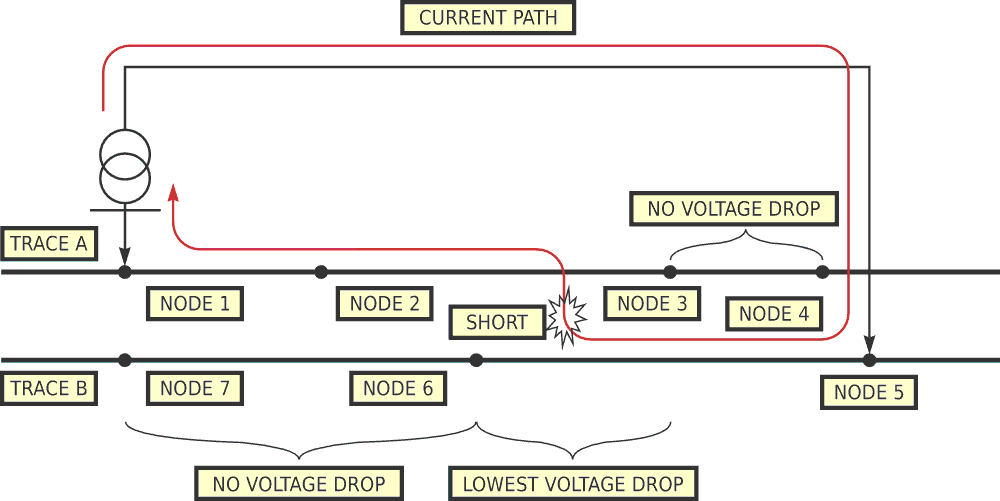
A node can be any accessible part of the circuit path under test, such as a via, a pad, or a test point (Figure 1). Note the current path: When current is flowing between two nodes, a minute voltage drop occurs across the two nodes. When the current doesn't flow between two nodes, there is no voltage drop across those nodes.
 |
|
| Figure 1. | By applying a fixed current to various nodes and looking at the resultant voltage drops, you can home in on the likely location of a pc-board short circuit. |
To find the short in this example, put one DMM probe on any node on Trace A and the other on any node on Trace B, and note the voltage drop. In this example, if you had started with the positive probe on Node 1 and the negative probe on Node 5 and moved the negative probe to Node 6, you would note a slight voltage drop. Next, you move the probe to Node 7 and note that the voltage drop is equivalent to the voltage drop at Node 6. From this test, you can deduce that the short must exist between nodes 5 and 6 because no current flows from Node 6 to Node 7. Then, move the positive probe to Node 2 and note a small voltage drop. Continue down the line to Node 3 and note another small drop. Next, probe Node 4 and note there is no voltage drop. You can now deduce that the short must be between nodes 2 and 3 and nodes 5 and 6.
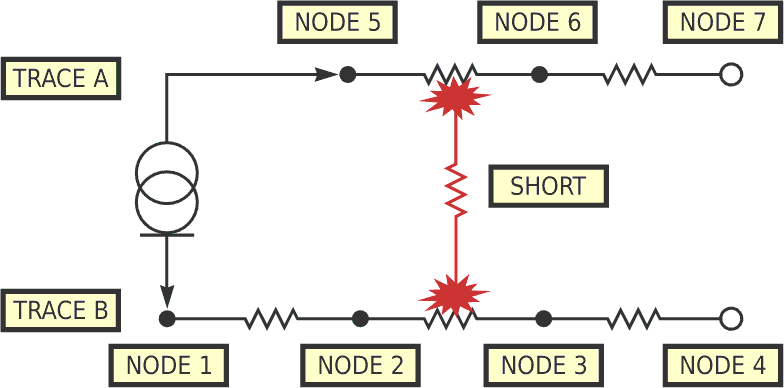
Redrawing Figure 1 with the equivalent circuit in Figure 2 makes clear how this technique works. You are now looking at a simple series network of resistors and looking for voltage drops across any resistor that has current flowing through it. When a node is outside the current path, no voltage drop occurs. By understanding the relationship of each of the vias and their position in the current path, you can systematically isolate the short by looking for lower voltage (current flowing) or higher voltage (current not flowing). When current is flowing, the short is farther from the current source. If no current is flowing, then the short is closer to the current source. This two-valued logic makes it simple to isolate the problem. The beauty of this technique is that it doesn't matter to which two nodes the current source is connected, as long as one side of the current source is connected to any node on Trace A and the other side of the current source is connected to any node on Trace B.
 |
|
| Figure 2. | The equivalent circuit of the pc-board layout shows the principal of the source-and-probe technique. |
In this example, the short is between two node pairs, and you can isolate the short only to those pairs. A little knowledge of the board layout and common sense now come into play. You need to know only where the two traces are adjacent between nodes 5 and 6 and nodes 2 and 3, and you have found the most likely place for the short. If it is underneath a component, you have to remove the component; removing the component often removes the short. If the short is on an internal layer, you may have to do some selective cutting and jumping to isolate the short from the traces, but at least you minimize the number of cuts on the board.