Op amps tend to make analog design easy. Maybe sometimes too easy?
Don’t get me wrong. I like operational amplifiers. Some of my best friends are op amps. They embrace such a wide range of varied capabilities, including low noise, high power, micropower, zero-drift, RRIO, high speed, etc., that they’re easy to love. They tend to make analog design easy. Maybe sometimes too easy?
This design idea applies the ΔVBE temperature measurement principle to make any cheap 3¾ digit digital multimeter with a 300 mV range into an accurate, linear, 0.1 °C resolution digital thermometer. As a (hopefully) entertaining exercise, this time it does it without incorporating any op amps. Here’s how it works.
ΔVBE temperature measurement is described and applied in an app note written by the famed analog design guru Jim Williams. See page 7 (Ref. 1). Williams explains that the ΔVBE/°C effect depends solely on the ratio of applied currents, independent of their absolute magnitudes, and has an amplitude of 198 μV per °C per current decade. 198 µV = 1 V/5050, so 198 μV/°C per current decade works out to
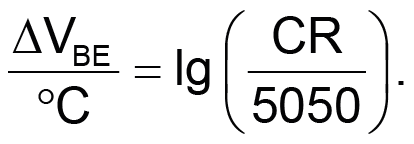
Therefore, for any chosen ΔVBE/°C, the required
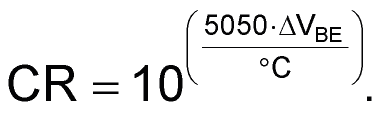
So if we want ΔVBE/°C = 1 mV, the solution couldn’t be simpler. We “only” need to set

Yikes!
The challenge, of course, is to achieve such an extreme current ratio. If the high side current were 1 mA, then the low side would have to be very (very!) low indeed… like 1 mA/316,228 = 3.2 nA low. This would involve Gohm current-setting resistors and circuit impedances in the multi-Mohm range. So it’s not so simple after all and in fact is very likely impractical – without op amps, that is.
But consider this. If it’s impractical to get enough ΔVBE signal from a single junction, why not wire N junctions in series and let their signals add up? For example, if N = 5, then to get the required 1 mV/5 = 0.2 mV, we only need

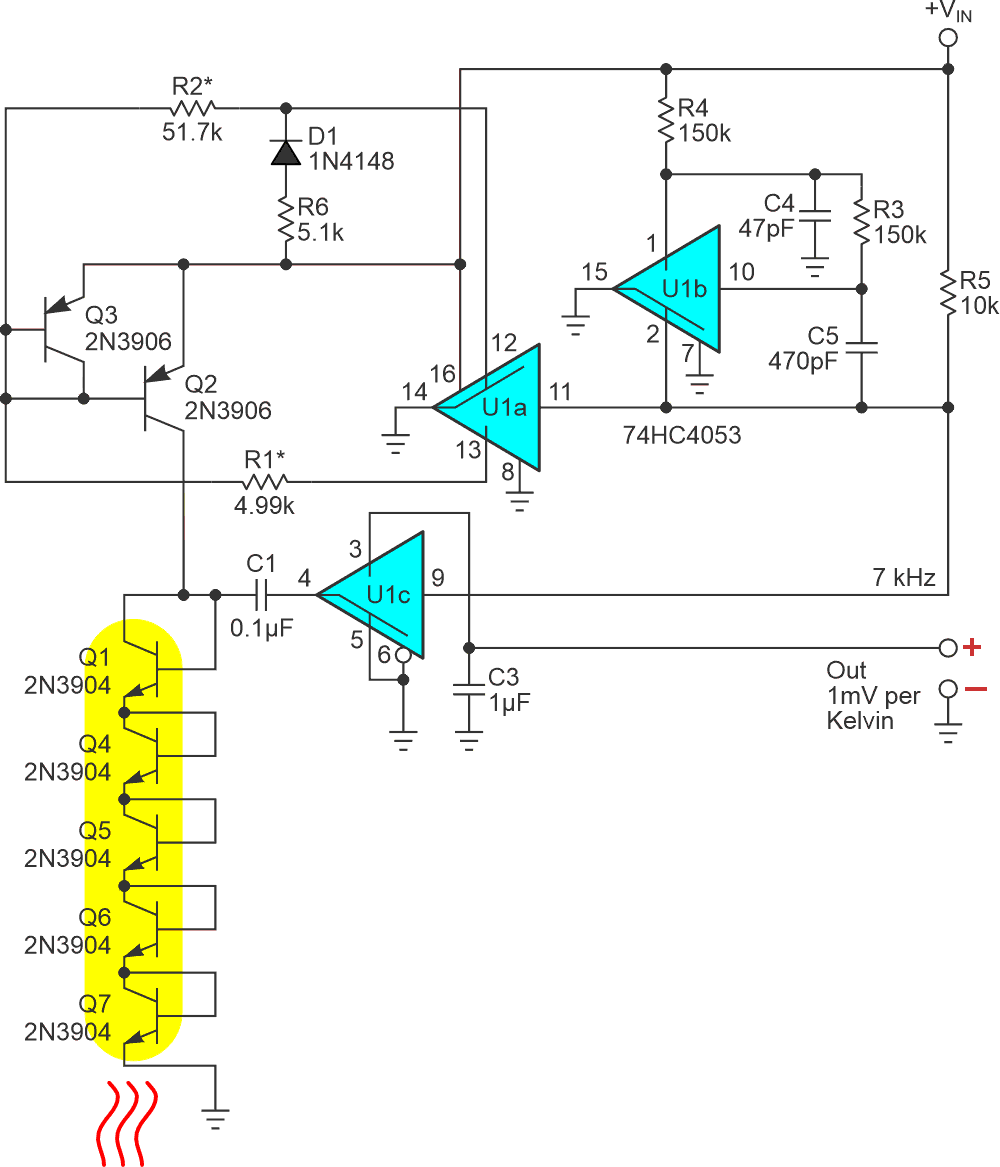
That ratio is highly practical. It’s exactly what Figure 1’s circuit does, in fact.
 |
|
| Figure 1. | Switch U1a and current mirror Q2Q3 apply an excitation current ratio of 10.23:1 to the 5 sensor transistor series array. This creates a 5 × 200 µV/°C = 1 mV/°C AC signal synchronously rectified by U1c. |
Circuit details include the D1R6 dummy load that serves to balance the currents passed by the two sides of the U1a switch, thus equalizing RON voltage losses. Current mirror aficionados (I’m looking at you, Ashu) will probably wonder how the Q2Q3 mirror, consisting of unmatched transistors with no emitter degeneration, can possibly have an accurate gain ratio? The answer, of course, is: it doesn’t. But that’s okay. It doesn’t need one.
Remember that Jim Williams said that the ΔVBE/°C effect depends solely on the ratio of applied currents, independent of their absolute magnitudes. So the mirror’s gain can vary as it pleases without significantly affecting temperature measurement accuracy. Multivibrator U1b provides ~7 kHz timing for synchronous sensor excitation and rectification with a ~33% duty factor. This takes advantage of the 10x lower sensor array impedance at the high-current side of the excitation square wave.
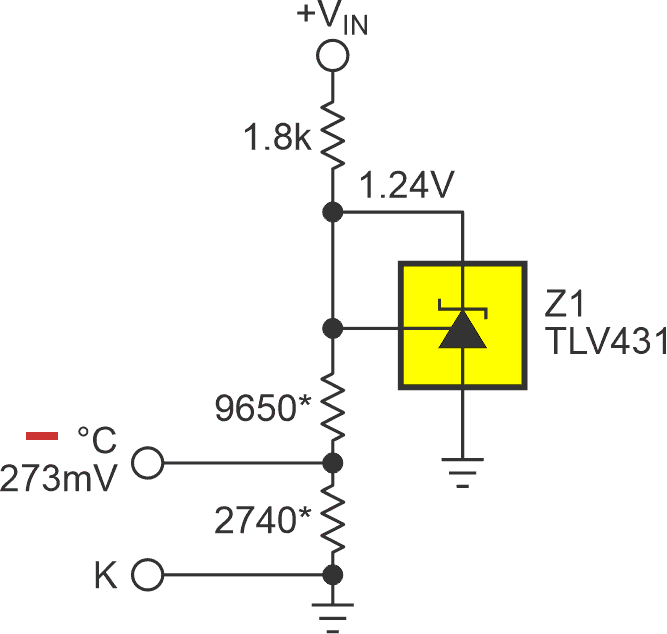
If a more usual temperature readout in Celsius rather than Kelvin is desired, just plug the minus lead of the DMM into Figure 2 instead of ground, to offset 273 K to 0 °C:
 |
|
| Figure 2. | This precision voltage reference converts Kelvin to Celsius. |
Speaking of variations that don’t spoil accuracy, the V+ supply, for example, can vary from 5 to 6 volts without affecting accuracy. Output impedance is roughly 2k, so variation of output loading by a typical 10M DMM input won’t impact accuracy, either. Who needs op amps, anyway? (Not a serious question!)
Thanks, Jim!
Reference
- Williams, Jim. "Measurement and Control Circuit Collection."