A subtle change to a standard circuit can enhance its usefulness – and even save a resistor.
If there were a prize for the most trivial Design Idea (DI) of the year, this one would likely be high on the shortlist (if not at the top). Most DIs involve adding components to circuits to improve them; this time we’re removing one. Circuits for line drivers, balanced or not, are ten a penny, but this variant has a surprising twist: surprising because it’s so simple and, when you look at it, obvious, though I can’t find it in any published schematic, even those from National Semiconductor’s golden days.
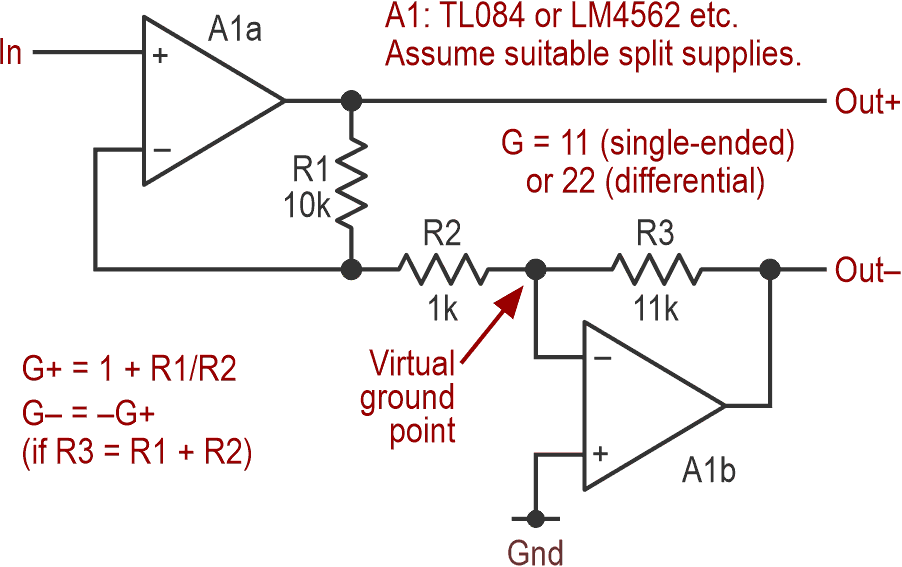
Figure 1 presents it.
 |
|
| Figure 1. | Resistors R1 and R2 help to set the gains of both the non-inverting and inverting stages, allowing for excellent matching of the anti-phased outputs with minimal components. |
A1a is a non-inverting gain stage, utterly conventional except that its feedback network is referred to A1b’s virtual ground point. A1b is an inverting unity-gain stage, utterly conventional except that its input resistor is also A1a’s feedback network. A1a and A1b therefore work together to deliver perfectly matched anti-phase outputs (assuming perfectly matched components, of course). The gain can be set to anything above 1 (unity gain would revert the circuit to a simple buffer plus an inverting stage: nothing new).
At first glance, this circuit may look rather like part of a differential or instrumentation amplifier. But its function, as determined by the resistor ratios, is quite different. Those others have accurately-matched differential inputs; this is designed for balanced outputs.
Is that it?
Yup: ’fraid so, apart from some practical details. A CR network may be needed to remove DC from the input, and any remaining imbalance could be trimmed by bleeding some current into (or out of) the A1b in- input. Otherwise, the circuit is stable and well-behaved, and will happily drive a transformer directly, though series matching resistors should be added, perhaps with 300R in each output line if you want to be really picky about balance.
Trimming the frequency response is messy, and should be done before the signal gets this far. Any (HF-cutting) capacitor across R1 (call it C1) needs to be matched by
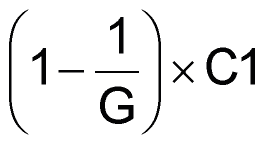
across R3 if the responses in both output legs are to match, where G is the gain.
The output drive differs from device to device. Using ±15 V rails and working into 600R, LM4562s delivered 26.3 V pk-pk and KA5532s gave 24.5 V, while TL072/082s disappointed at just 13.8 V. An MCP6022 (RRIO, unlike the others) with ±2.5 V supplies clipped at 4.7 V pk-pk into 600R.
And in the real world…
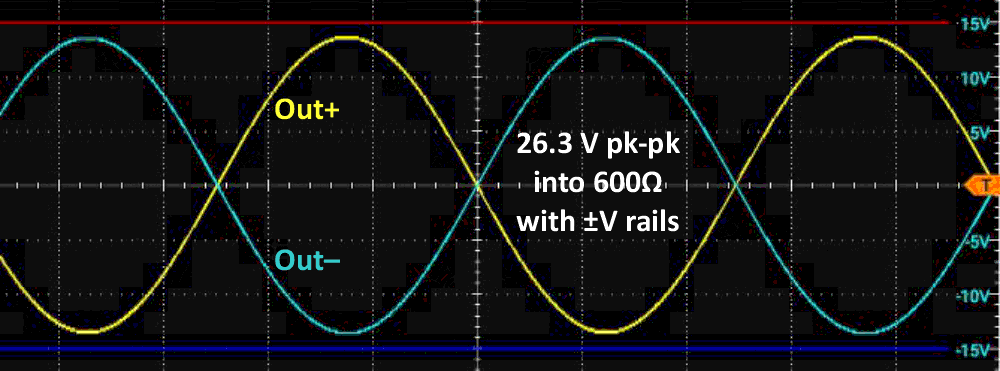
To paraphrase Bob Pease, “If a circuit’s never seen a soldering iron, it probably won’t work right” (although perhaps he’d make an exception for plug-in breadboards, at least at low frequencies). So, just to demonstrate that this doesn’t merely describe a simulation, Figure 2 shows it plugged in and “working right”.
 |
|
| Figure 2. | This is how an LM4562 performs at 1 kHz with ±15 V rails and a 600R load. It is just clipping – cleanly and symmetrically – at a differential output level of 32.2 dBu. |
As noted earlier, the circuit is well behaved as long as you avoid driving capacitive loads directly, as with all op-amp circuits (33–100R in series with an op-amp’s output pin is normally a good cure, limiting the peak current). Lacking any suitable audio transformers but wanting to check if such loading might cause problems, I hooked it up directly to the secondary winding of a small mains transformer, which seemed like a cruel enough (not to mention fun) test.
While the resulting >>300 V RMS output tolerated little loading, it could light a neon brightly (with its integral 220k series resistor) without affecting the distortion at the op-amps’ outputs. Although the HV output showed a nick in the waveform where the neon struck and went negative-resistance, this artifact wasn’t reflected back to the drive. Which is exactly what we’d expect, but should not take for granted.
For phase-splitting with gain (but no pain) and the ability to drive old-school 600Ω balanced lines, this circuit may be ideal. That said, there may be easier and cheaper ways of powering neons…