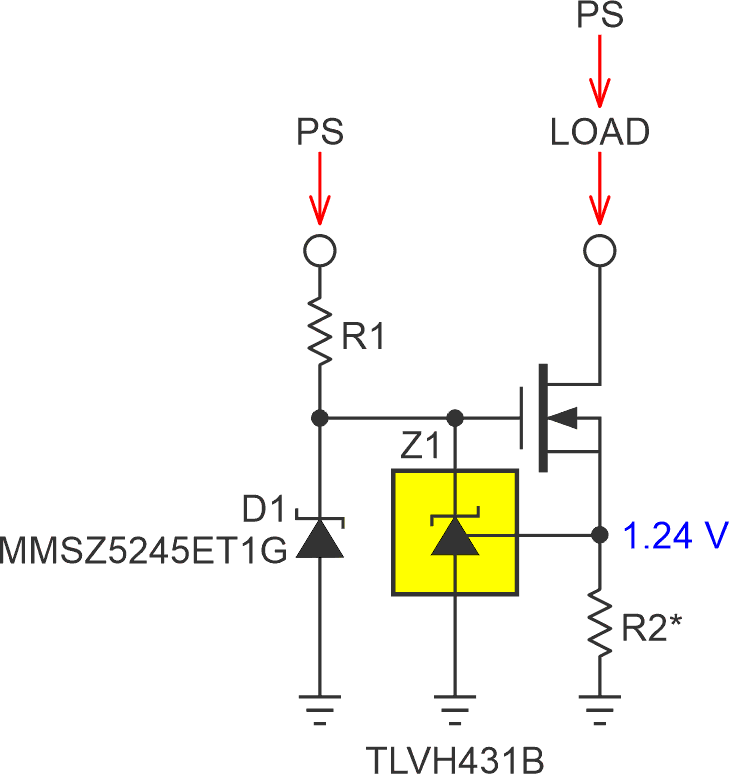
An interesting analog design problem is the precision current source. Many good designs are available, but most are the three-wire types that can be used as a positive (see Figure 1) or a negative (Figure 2) polarity source, but not both from the same circuit.
![A typical three-wire [power supply (PS), ground, and load] precision positive current source offering an accuracy of 1% or better. The output current is 1.24/R2.](https://www.rlocman.ru/i/Image/2025/12/22/Fig_1_Eng.gif) |
|
| Figure 1. | A typical three-wire [power supply (PS), ground, and load] precision positive current source offering an accuracy of 1% or better. The output current is 1.24/R2. |
 |
|
| Figure 2. | A typical three-wire negative current source, or a current sink. |
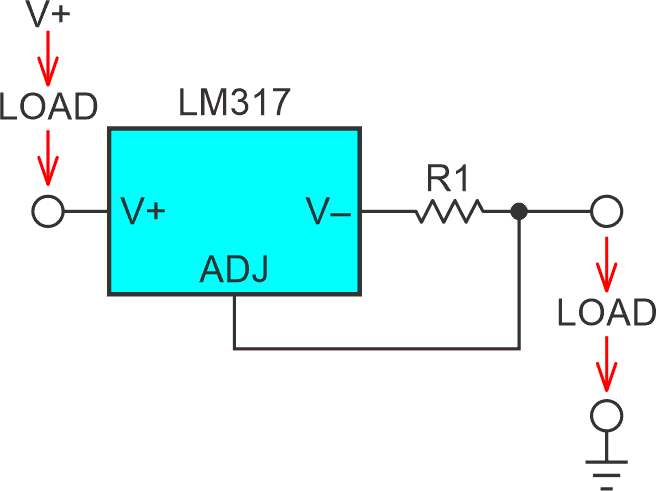
Two-wire designs exist and have the advantage of being able to serve in either polarity connection. Some of them are simple and cheap but somewhat limited in terms of performance. See Figure 3 for a classic example.
 |
|
| Figure 3. | A textbook classic two-wire current source/sink where 40 V > (V+ – V-) > 4.5 V. |
Amazingly, this oldie but goodie comprises just two commodity components, one of which is the single resistor that programs it (R1). Its main limitation is a (conservative) 10 mA minimum output current:
Output current = 1.25/R1 >= 10 mA and <= 1.5 A
Accuracy (assuming perfect R1) = ±2%.
In other news, a recently published high-performance, ingenious, and elegantly simple Design Idea (DI) for a two-wire source comes from frequent contributor Christopher Paul. Christopher Paul’s circuit significantly extends the precision and voltage compliance of the genre. See it at: “A precision, voltage-compliant current source” (Ref. 1).
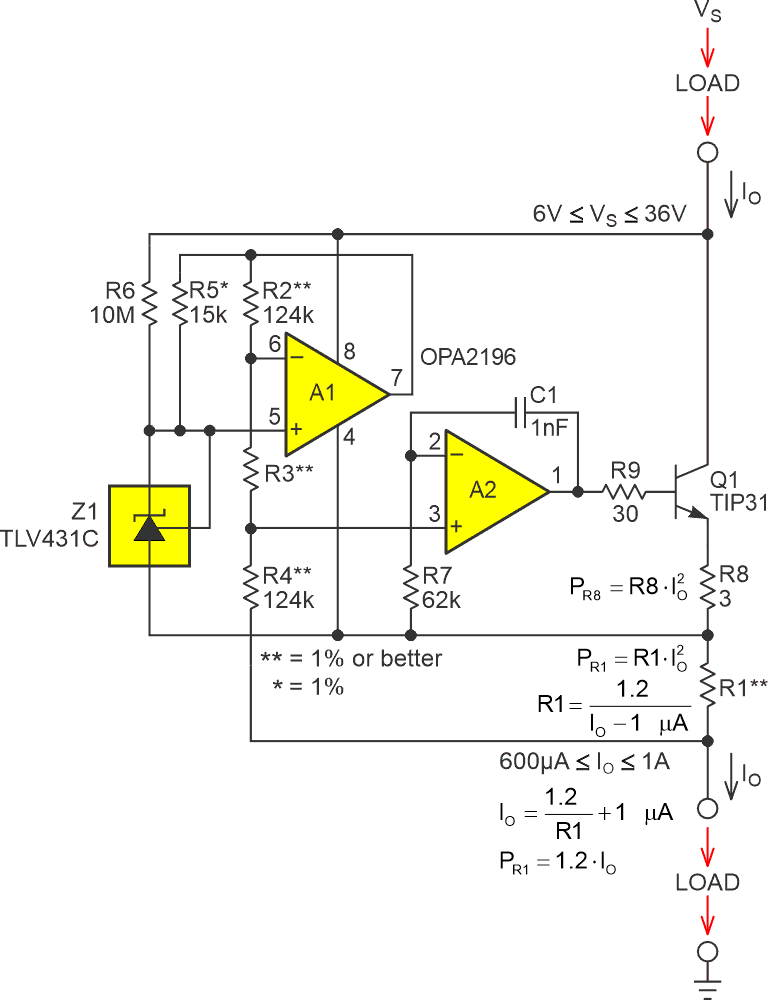
Meanwhile, my effort is shown in Figure 4. This design takes a different approach to the two-wire topology that allows more than a 1000:1 ratio between maximum and minimum programmed output. It boasts uncompromised precision over the full range.
 |
|
| Figure 4. | A two-wire source/sink with 1% or better precision over > 1000:1 output range. |
Here’s how it works.
The precision 1.24-V reference Z1 is the heart of the circuit. Start-up resistor R6 provides it with a microamp-level trickle of current on power up. That’s not much, but all it needs is to squeak out more than A1’s 100 µV of input offset.
Then, A1’s positive feedback from R2 will take over to regeneratively provide Z1 with the required 80 µA of bias through R5. At this point, the A1 pin 5 will stabilize at 1.240 V, and R3 will pass 10 µA.
That will pull A2 pin 3 positive and coax A2’s to turn on pass transistor Q1. The IO current, passed by Q1, will develop output-proportional negative feedback across R1.
This will sink 10 µA (1.24 V/R4) current through R4, nulling and balancing A2’s non-inverting input and its output. This will set
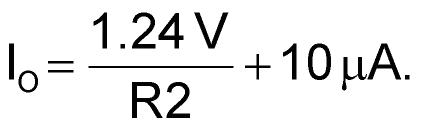
Damping resistors R8 and R9 together with compensation network R7C1 provide a modicum of oscillation and other naughty behavior suppression. This will generally encourage docile niceness.
The minimum programmable IO budget consists of op-amp current draw (500 µA max) + Z1 bias (82 µA max) + R4 feedback (10.1 µA max) + R6 trickle (4 µA max) = 596 µA. The maximum IO is limited by A2’s output capability and Q1’s safe operating area; 1 A is a conservative ceiling.
Although both op-amp and Q1 are rated for 36 V, don’t overheat them with more voltage than the load compliance requires. Even then, for output in the ampere range, Q1 will definitely need a robust heatsink, and R1 and R8 need to be big and fat.
Reference
- Paul, Christopher. "A precision, voltage-compliant current source."