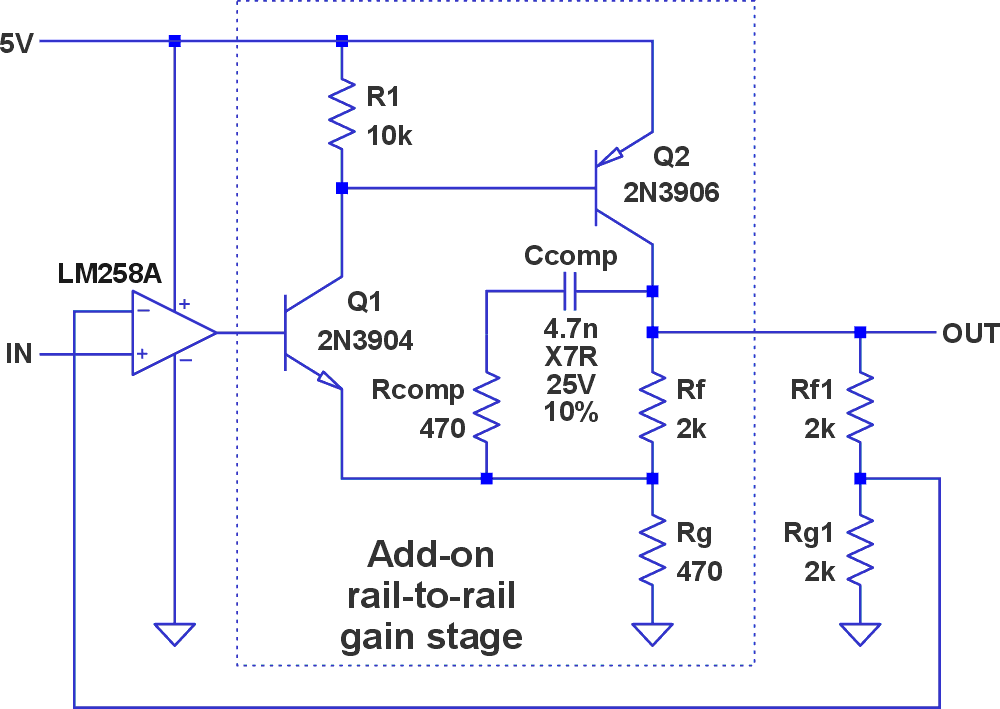
The LM358 family of dual op amps is among those hoary industry work-horse devices that are inexpensive and still have their uses. These parts’ outputs can approach (and for the inputs even include) their negative supply rail voltage. Unfortunately, this is not the case for the positive supply rail. However, cascading the op amp with a few simple, inexpensive components can surmount this limitation of the outputs (Figure 1).
 |
|
| Figure 1. | This simple rail-to-rail gain stage, consisting of Q1, Q2, R1, RF, RG, RCOMP, and CCOMP, is driven by the output of the LM258A op-amp. Feedback network RF1 and RG1 help to ensure that the inverting input feedback voltage is within the op-amp’s common-mode input range and to set a stable loop gain characteristic. |
I had some LM258As on hand, which I had bought instead of the LM358As because of the slightly better input offset voltage and bias current ratings, which also spanned a wider set of temperatures. Interestingly, the input common-mode range for the non-A version of the part is characterized over temperature as VCC – 2 V for VCC between 5 and 30 V. But the A version is characterized at 30-V only. Go figure! As you’ll see, the tests I ran encountered no difficulties.
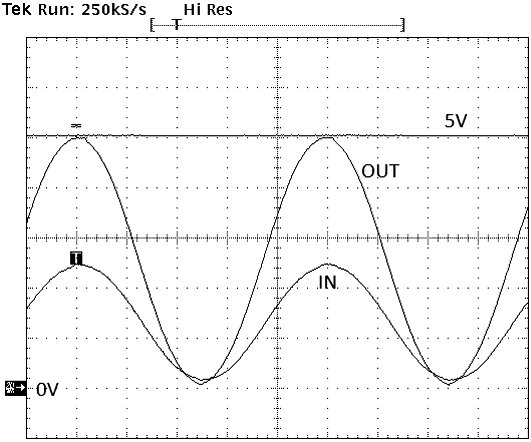
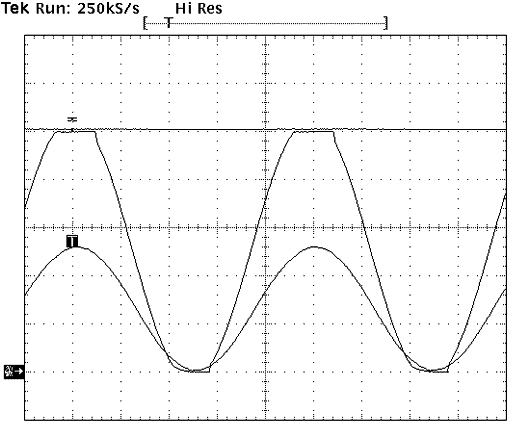
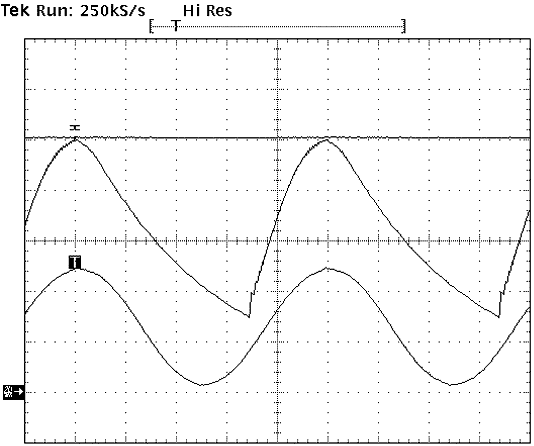
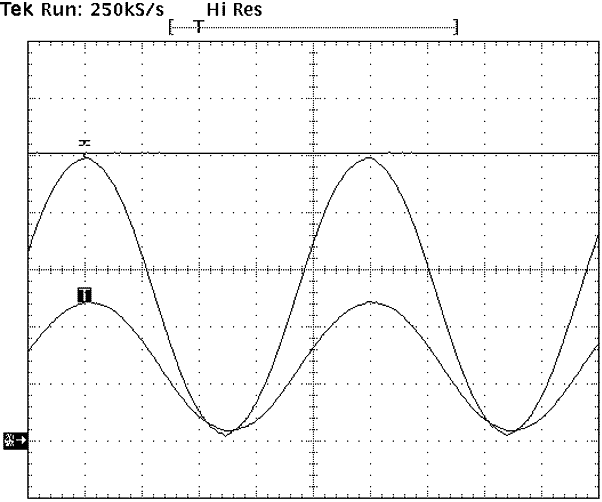
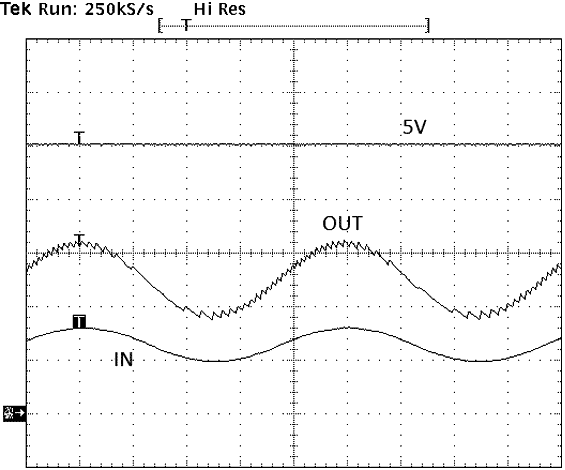
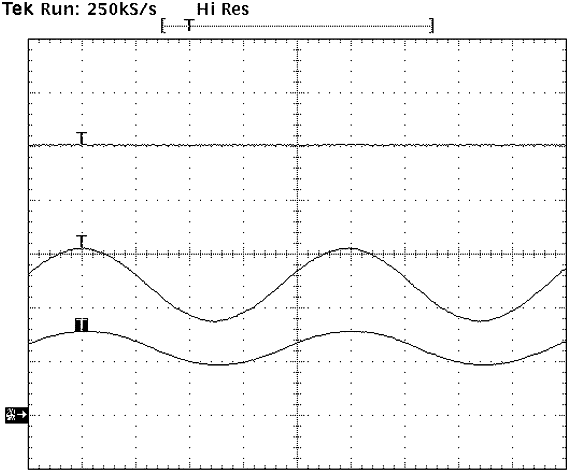
The parts’ AC characteristics are spec’d identically, suggesting that the even cheaper LM358 should encounter no stability issues. With the components shown in Figure 1, the loop gain above 100 kHz is about that of the LM258A configured as a voltage follower. Below 10 kHz, there’s approximately an extra 8 dB of gain. The following (Figures 2 through Figure 7) are some screen shots of ‘scope traces for various tests of the circuit at 1 kHz. The scales for all traces are the same: 1 V and 200 µs per large divisions.
 |
|
| Figure 2. | Here, rail-to-rail swings of the circuit’s output are apparent. |
 |
|
| Figure 3. | The circuit recovers from clipping gracefully.граничения. |
 |
|
| Figure 4. | With a 0.1 µF load, slewing problems arise. |
 |
|
| Figure 5. | A 470-ohm load in parallel with 0.1 µF is stable and doesn’t exhibit slewing problems. |
 |
|
| Figure 6. | But with 0.1 µF as the sole load, the circuit is not stable. |
 |
|
| Figure 7. | Swapping the 470-ohm RCOMP with 100-ohms restores stability with 0.1 µF as the sole load. |
In conclusion, a pair of cheap transistors, an inexpensive cap, and a few non-precision resistors provide a cost-effective way to turn the LM358 family of op amps into one with rail-to-rail output capabilities.