After more than fifty years of continuous production in bipolar and fully half that in CMOS, there’s really neither room nor reason to question the value and versatility of the venerable 555 analog timer. But if it has any significant limitation, it probably lies in the category of raw speed. Still, the LMC555 datasheet tells (albeit in a rather obscure footnote) of an impressive 3 MHz capability. The details (including the 3 MHz test circuit) appear in Figure 6-2 on page 6 of 2024 datasheet.
 |
|
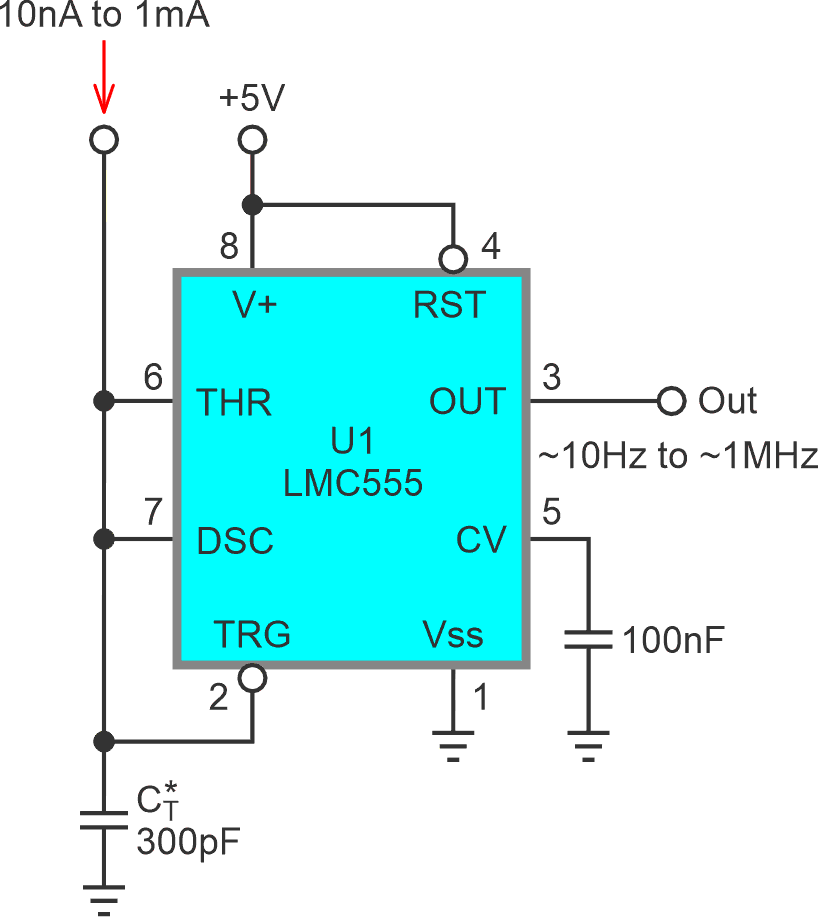
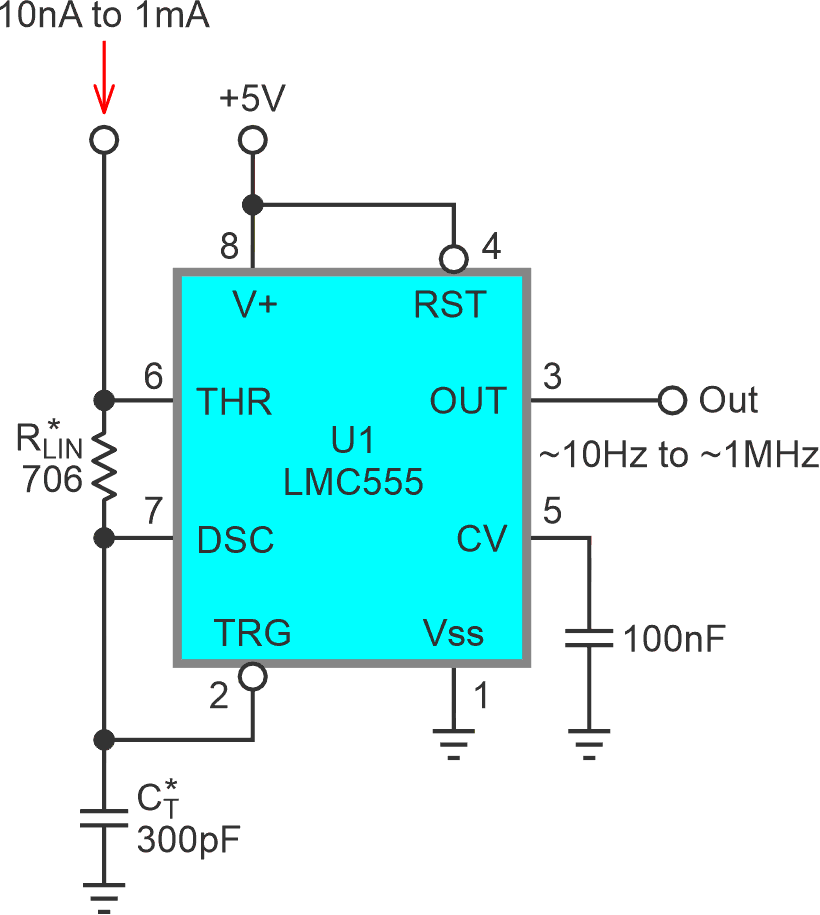
| Figure 1. | A super simple, 5-decade LMC555 current-controlled oscillator. |
3 MHz for a decades-old, low-power, geriatric analog part isn’t too shabby. It suggests the delightfully simple topology of Figure 1 for a precision 5-decade 1-MHz, current-controlled oscillator, where:
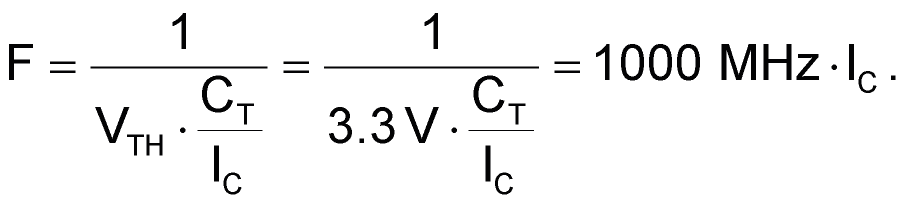
Figure 1’s LMC555 is doing duty as a current-controlled oscillator with only two external components. It boasts a frequency range spanning 5 decades from 10 Hz to (approximately) 1 MHz. Cool!
But wait. What’s this “approximately” thing? How problematic is it, and mainly, how can we fix it if it is a problem? Here’s how.
The usual data sheet expression for LMC555 frequency of oscillation (FO) is:
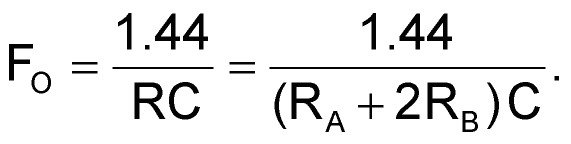
But in Figure 6-2, the 3-MHz test circuit, they show RA = 470, RB = 200, and C = 200 pF. Those numbers, when plugged into the data sheet arithmetic, yield an RC time constant of 121 ns and therefore predict that the oscillator frequency should hit, not just 3 MHz, but a figure nearly three times faster.
Hold the phone! If 3 MHz is as fast as they can really go, what happened to the missing 5 MHz?
What’s happening is simply that, besides the explicit 121 ns external RC time constant, there’s an implicit time delay (TD) internal to the device of:

These 212 ns of internal delay, while short enough to keep the datasheet cookbook arithmetic accurate for low to moderate frequency, need attention if we want to push things anywhere near pedal-to-the-metal multi-MHz limits. A formula for usefully accurate high-frequency FO prediction thus becomes more like:
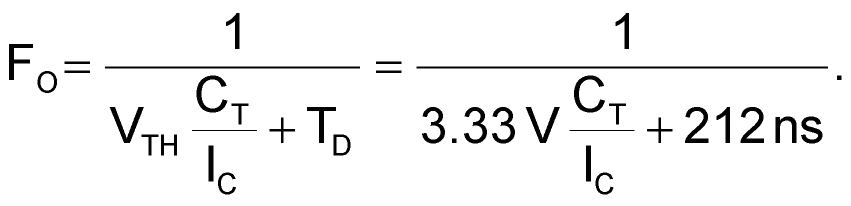
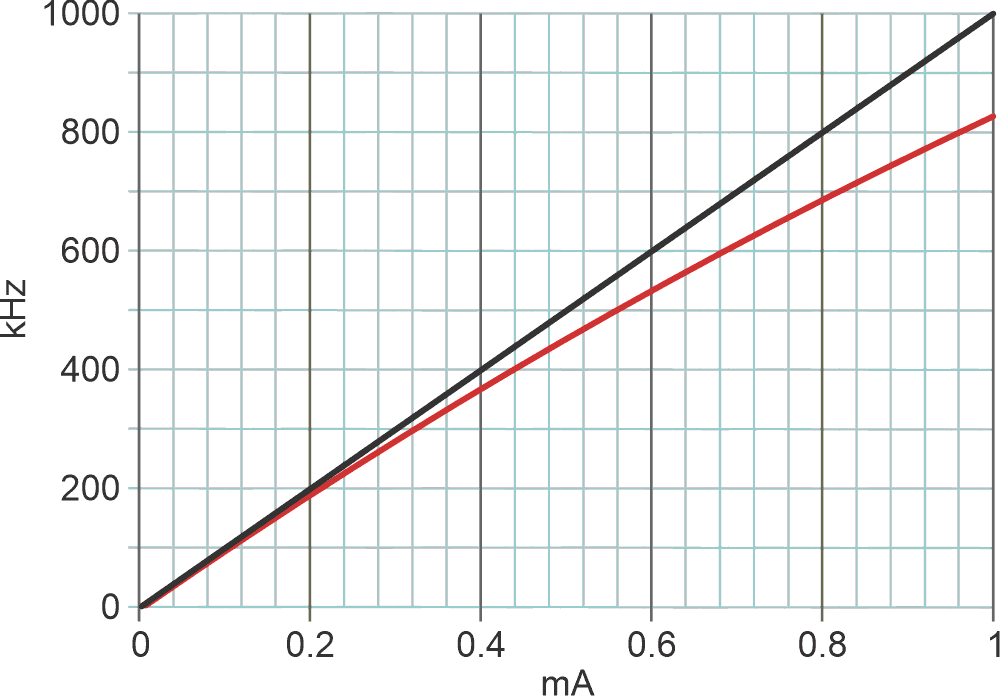
When plotted out, this equation generates the droopy red curve in Figure 2 with a > 20% error at 10 mA, which should be 1 MHz but is really only ~800 kHz. Okay. That is pretty pitiful.
 |
|
| Figure 2. | Nonlinear red curve versus ideal black shows ~20% error from LMC555 internal delay. The y-axis is the output frequency. The x-axis is the control current. |
Luckily, a fix is both available and absurdly easy. It consists of merely a single resistor RLIN added between the DSC (discharge) and THR (threshold) pins. It works to linearize the current vs frequency function by biasing the THR pin upward by a voltage = ICRLIN. This abbreviates the duration of the sawtooth timing ramp by:
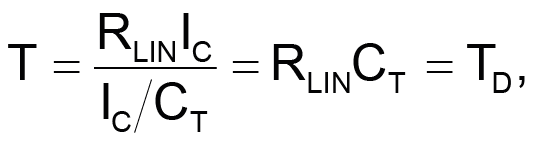
Thus, cancelling the 555 internal delays.
 |
|
| Figure 3. | Nonlinearity compensation for 555 internal delays when RLINCT = TD = 212 ns. |
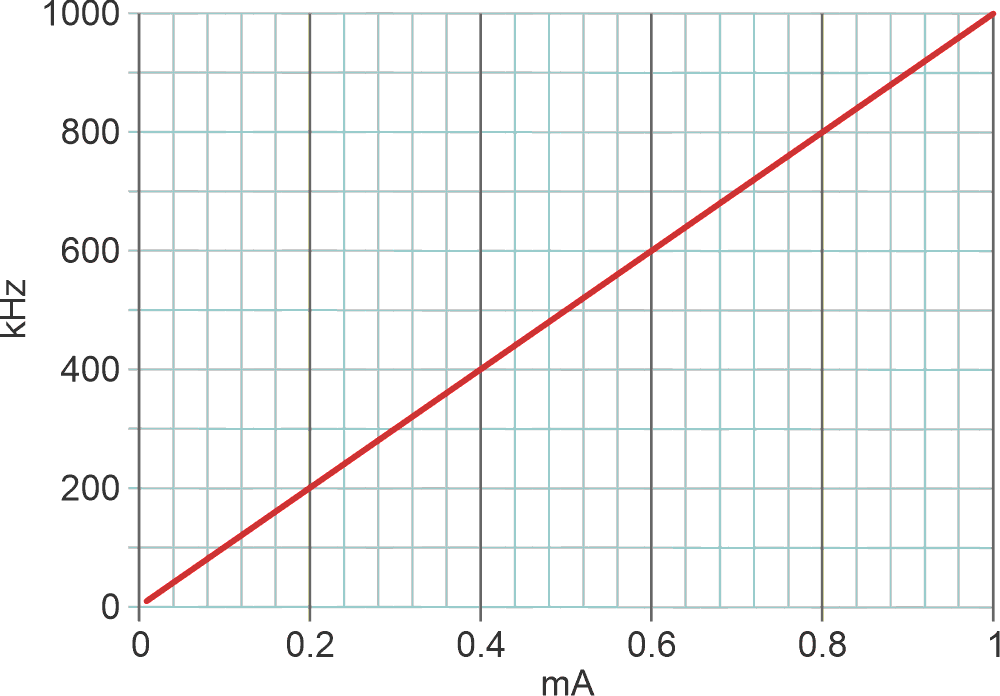
Therefore, if RLIN is chosen so that RLINCT = TD as shown in Figure 3, nonlinearity compensation will be (at least theoretically) complete over the full range of control current as shown in Figure 4. Note:

 |
|
| Figure 4. | Frequency of oscillation nonlinearity is foregone and forgotten if RLIN = TD/CT = 212 ns/300 pF = 706 ohms. |
Theoretically.
So the question arises: Can anything practical be made of this theory? More on this soon.